The “me too” works…

Over the last few years, I notice (though it might be anecdotal since I haven’t done a thorough review) that the less original content is present in a poster or talk, the less likely someone is to acknowledge that their work is a remake and seems to simply skip proper referencing. This year, I have seen a perfect (and I mean it!) remake of a work we have published three years ago. The talk did not even had a single reference, not just to our work but to any works…


These talks or posters are basically presented as original, totally new. Is this a failure of the supervisor when attributing the topic or that of the student for failing to do a proper literature review?

Research ethics, informed consent and Facebook

Yep, Facebook experimented with 700 000 of its users without their knowledge, and published their results in PNAS!


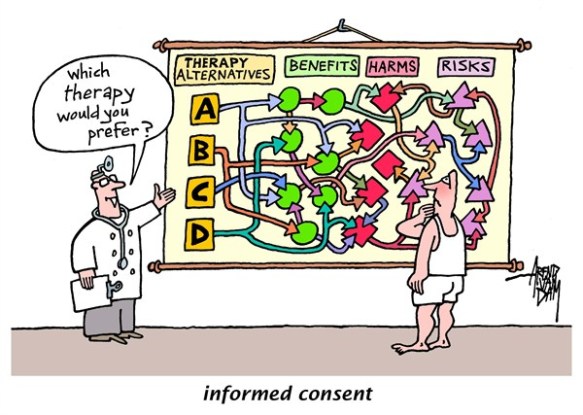
The general explanation: the users consent to anything and everything for the rest of their lives (Facebook lives) when they signed up to use the service. By that measure, every patient coming to our medical clinics agrees to be part of an experiment or trial and their data used for publication because they have agreed to be treated… OK, I am pushing the boundary a bit (maybe a lot) here but you get the picture and it is a bit absurd.

119731_600(* Cartoon from the Cagle Post by )


However, this has lead to an interesting post on the concept of informed consent, which is at the heart of this kind of studies. It is an essential condition (but not the only one) to allow clinical or drug trials and robustly enforced by ethic committees, at least in the OCDE countries. While hospitals and physicians can use patient data for quality assurance purposes, publication of the said data cannot be made without the patient informed consent.


This could be a great general public education opportunity.


Privacy, convenience, freedom and security or Android as the biggest trojan horse of all time

There was a very nice article recently following the first year after the revelations of Edward Snowden on how it become really easy even for regular citizens to “track” someone online. While all of this NSA business is often link to a debate of freedom vs. security, the biggest concerns should maybe not be NSA but the new Kings and Monarchies of our time aka (some) mega corporations.

Theprocessionofthetrojanhorseintroybygiovannidomenicotiepolo

We have hear and seen repeated for a long time the quote of Benjamin Franklin on freedom vs. security. However a more pervasive attitude is at play, and I must say that I am playing it like many others to some extent: giving away (some of) my privacy for convenience. One can ask how far would it go?


Things were looking to go better when Apple announce iOS8 and OSX 10 in which extra layer of security was added, going all the way to even hide your critical data from Apple itself (so employees or external agencies could not get their hands on it!).  Apple will also add MAC address randomization so you cannot be tracked without your consent as you get into various Wi-Fi zones.


Since then three announcements, each at 180 degrees from Apple, appears to decrease privacy significantly for, in principal, added convenience:


Each of the above announcements means that these companies will collect more information on you and in the end will know more about your general and detail behavior that even you can recalled from memory. The quote from Google Android Chief is quite explicit about this; they want to know where you are and what you do in real-time, all the time…


It turns out that the Android is becoming the biggest Trojan Horse virus of all time. First it is “free”, second it is adopted willingly and third Google is at the receiving end of all that information. It is the free part that is the central issue. The truth is than Android is not free. it pays itself by collecting your personal information…and that information by itself and aggregated by categories is extremely valuable to Google and to any one it see fits to share it with or sell to. Google business model is to sell advertising i.e. to sell the best “picture” you at any given point in time to others.


In fact, one might contend that receiving these so-called “free” software and hardware is probably not a strong enough retribution for the worth of your personal information: you are really worth more then you think and are probably being exploited without realizing it.


The scary part is to understand how wide is the gap between total lost of privacy and that of freedom? The next few years will be interesting.

Roam Mobility: a cell phone solution for Canadian traveling to the USA!

In Canada, we are stuck with some of the worst (read most expensive) cell phone plans of the OCDE countries (see also Michael Geist Blog).
Things are even worst if you travel abroad with your cell phone and keep your current provider of service: welcome to the wonderful world of roaming charges. Here is are things look as of June 7th 2014:
Bell: Roaming charges 1.45$/min, 6$/Mb and 0.75$/text or pay 20$ for 100Mb or 50$ for 500Mb and so on
Rogers : Packages consisting of 40$ for 50 min, 200 Mb of data / 80$ for 100 min and 500 Mb of data.
Similar fees can be obtained for other Canadian providers.
RoamMobility
Recently found the solution to this, let’s call it, problem: Vancouver-based Roam Mobility . You can get a Sim Card from Roam Mobility that gives you a “permanent” USA phone number and nice roaming prices and options:
  • Unlimited nationwide talk
  • Unlimited global text
  • Unthrottled high-speed data
  • Free long-distance calls to Canada (yes!)
  • Voicemail and caller ID
So, how does it work? You either buy you Sim Card directly from Roam Mobility or, as I did, in a Staples store (“Bureau en Gros” in Quebec). When you register your Sim Card on Roam Mobility web site, you are attributed a USA phone number that will be valid as long as you use the service once per year. You than chose a package for 1, 3, 7, 14 or 30 days (there is also an option for those who have longer stay)
  • Data only
  • Text and talk
  • Text, talk and data
Once you pick your plan, you also chose online your activation data and time. For my part, I picked the landing time of my flight. So the only thing you have to do is to change your Canadian Sim Card to the Roam Mobility Sim Card (assuming that your phone, like mine, is unlock). Note, you need to carry the Sim Card holder opener tool (or a small paper clip). If you never change your phone Sim Card, there are ample instruction on YouTube. Here is the one for the iPhone5/5s. Changing the Sim Card takes only a few seconds; no need to shutdown your phone.
Once done, change the APN to roam (no password) and that’s it, your ready to go. On IOS 7, this is what the previous link will tell you to do:
  • Select Settings
  • Select Cellular
  • Select Cellular Data Network
  • Under the Cellular Data section change the APN to the word roam(Username & Password should be blank)
  • Scroll down and under the Personal Hotspot section change the APN to the word roam (Username & Password should be blank)
  • Save the setting and restart your phone

If this is the first time you use you card, you will be walked through the setting of your USA voice mail once your phone is activated at destination. No your Roam Mobility Sim Card does not work within Canada 😦

The plans are 3.95$ for 1 day (300Mb of data), 11,95 for 3 days (900Mb of data), 27,95 for 7 days (2Gb of data included), … And yes you can share your data with your iPad or computer. This is a fraction of the cost charged by our Canadian providers for roaming charges or “travel packages”.

Plans

It worked flawlessly and when landing in Canada, simply put your Canadian Sim back in the phone and store you Roam Mobility card for your next trips.

Brilliant 😉

P.S.: Roaming Sim Card and packages are even less expansive in Europe. I’ve tried Austria and Belgium up to now. So if you travel even moderately, paying up front you cell phone and having it unlock gives you access to very good deals outside the country.