
I am Charlie / Je suis Charlie
Image
Reply

This velocity is so nearly that of light, that it seems we have strong reason to conclude that light itself (including radiant heat, and other radiations if any) is an electromagnetic disturbance in the form of waves propagated through the electromagnetic field according to electromagnetic laws.
James Clerck Maxwell, A Dynamical Theory of the Electromagnetic Field (1864), §20
If you are like me, you are probably receiving at least a few “invitations” per week to submit you latest and greatest research to an open access journal…that you have never heard of before. The fees are small and the editorial board is supposed to be at the forefront of the field.
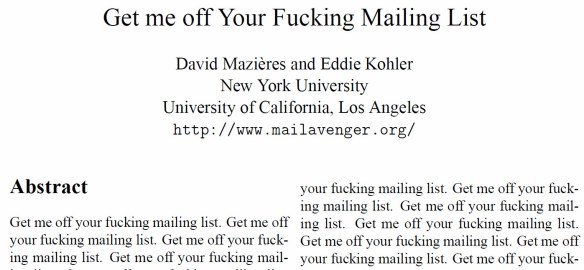
Scholarly Open Access blog ran an eye opening, albeit extreme, story of two UCLA researcher that simply had enough and made the proof that some of these are simply bonus journals. The whole paper is based on a single sentence “Get me off Your Fucking Mailing List” for 10 pages (PDF here). The figures of the paper are quite ingenious and the editor acceptance letter and review letter have made me laugh for a good 5 minutes non stop 😉
Scholarly Open Access keeps a list of potential predatory editors and journals. Have a look.
Things Blog is announcing a give away for the latest version of Things for iPhone and iPad and a good amount off the Mac version. Been using Things for a long time (the very first beta in fact!). An excellent and very easy to use task management tool.
Is looking for microRNAs in the bloodstream the silver bullet for cancer detection? Have a look at Jorge Soto talk at TEDGlobal 2014.
Notice that he uses his iPhone integrated camera for image taking and automated analysis. And did I say, Open Source design 😉
For the young (and not so young) scientists, a very interesting interview from earlier on this year with the 2002 Physiology / Medicine Nobel Winner on innovation and scientific publishing.
Some very interesting thought about the need to tackle something you know nothing of in order not to bring your own biais:
The thing is to have no discipline at all. Biology got its main success by the importation of physicists that came into the field not knowing any biology and I think today that’s very important.
I strongly believe that the only way to encourage innovation is to give it to the young. The young have a great advantage in that they are ignorant. Because I think ignorance in science is very important. If you’re like me and you know too much you can’t try new things. I always work in fields of which I’m totally ignorant…
And on the business of publications and the impact factor scam:
I think peer review is hindering science. In fact, I think it has become a completely corrupt system. It’s corrupt in many ways, in that scientists and academics have handed over to the editors of these journals the ability to make judgment on science and scientists. There are universities in America, and I’ve heard from many committees, that we won’t consider people’s publications in low impact factor journals.
Now I mean, people are trying to do something, but I think it’s not publish or perish, it’s publish in the okay places [or perish]. And this has assembled a most ridiculous group of people…
A very interesting read: How Academia and Publishing are Destroying Scientific Innovation: A Conversation with Sydney Brenner | King’s Review – Magazine.
 Ruminating...