On the go…

On the go…

Here is a few tools I really appreciate to carry with me on the go:
  • iPad: I do all of my reading and manuscript editing on it!
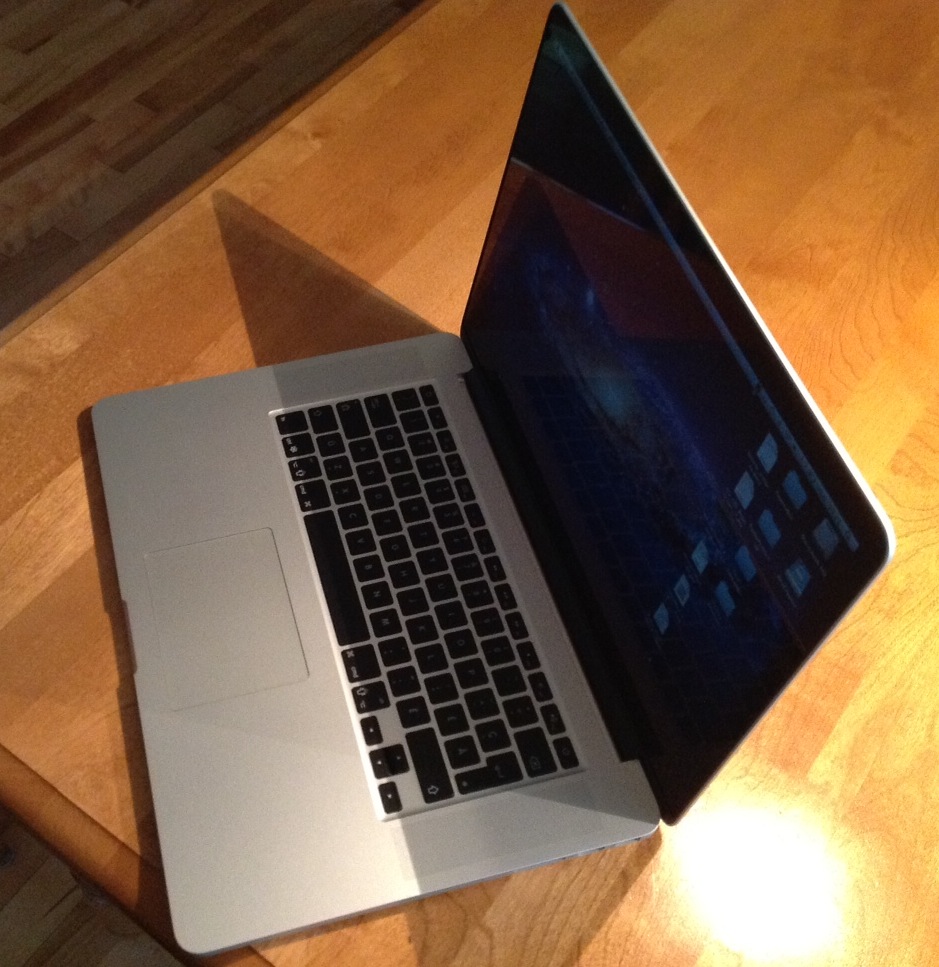
  • MacBook Pro Retina display: only on buisiness trip longer than a few days or if I need to finish that last presentation (Keynote for iPad works ok for simple presentations or when the presentation is ready. I still find it easier to build a presntation on the Mac).
  • Cables / Adaptors Organizer: I recently discovered the Coccon Grid-It. It is a simply, elegant and efficient organization system. The picture above shows a fully loaded “grid” with cables, adapters and so on. Just put it in your bag, very robust; nothing came out of it on my last trip (21 hours of plane, 28 hours of total travel and 4 airports later)
  • PlugBug: I really like Twelve South PlugBug power adapter for iPod/iPhone and iPad. The nice thing you can fit it on the top of the MacBook adapter so that it uses a single wall plug.
  • Logitec usb+laser presentation tool.
  • Bose QC 15 for those long flight. Very confortable and highly efficient noise cancelling. I found that it does make a difference on long flights. I did own cheap noise cancelling headphones for the past few years. I have to admit that the QC15 are really in a different class.
  • Digital camera: Just replace my iPhone3GS with a iPhone 5 two weeks ago (just in time for conference travels 😉 ). As advertised, I found that it covers my needs for pocket size camera and business trips photography very nicely. Of course not in the same category of a full-fledge Canon or Nikon camera but my pictures of the Sydney Taronga Zoo are really quite good.
  • Good old pen: you have to fill out those custom forms after all.

Here’s to the crazy ones…

“Here’s to the crazy ones. The misfits. The rebels. The troublemakers. The round pegs in the square holes. The ones who see things differently. They’re not fond of rules. And they have no respect for the status quo. You can quote them, disagree with them, glorify or vilify them. About the only thing you can’t do is ignore them. Because they change things. They push the human race forward. While some may see them as the crazy ones, we see genius. Because the people who are crazy enough to think they can change the world, are the ones who do.

– Apple Inc, Think Different “

I’ve said it a couple of times, I like computers and electronic gadgets, in particular those gadgets that do what they are supposed to do without getting in the way. You can just use them and they work (for a useful amount of time)!

I got my first computer in early 1983 (a small Radio Shack unit) followed a few months later by a C64. It was a great computer and learned a lot of programming from it. But when I saw a Mac and had the chance to work with one in school in 1985, I knew what a computer would looked like moving forward. This gaming changing business happened again a few times for Apple. Before the iPhone, most “smart” phones where really not that smart and the top of the line was the Blackberry (an e-mail on the go device). Even early version of Android was geared toward competing with the BlackBerry…2007 marked a pivotal year for smartphone, and nobody ever looked back (expect for those trying to revisit history after the fact). The same is true for tablet computing. Tablets have been there for a long time before the iPad but it was not even considered a factor in term of selling volume. Just a few years after the iPad, the tablet is now a bigger market than the “traditional” PC.

The most interesting things about all of the above is that when launched, all were declared DOA by most “market experts” : computers with GUI were toy computers just good for playing (and I am not even talking about the mouse…), iPhone was Apple biggest mistake since no one in its right mind would buy a phone that has no physical keyboard and buttons. The iPad was just a big iPod Touch, no way of doing real work on them. The truth is that all of the above broke or shifted a paradigm, a way of doing things that was so entrenched that they were seen as set in stone.

The same is true for many aspects of life, including scientific research. Once in a while, you get comments that your research program or project (or even paper) cannot be successful because that would mean the usual way of doing things, of thinking would have to change. Oh boy, that would be so impractical…

This leads me to the quotation used in the opening of this blog post and Steve Jobs.

Steve jobs passed away over one year ago (on October 5th 2011). Yet I find it fascinating how much it still written, especially online, about him even today. Some praise him as one of the genius of our time. Others, like to tell that he or Apple, in fact, didn’t do anything all. It does not really matter; the point is, as stated in the quote: “you can quote them, disagree with them, glorify or vilify them. About the only thing you can’t do is ignore them.”. Clearly, he was someone who still can’t be ignored 😉

Steve Jobs delivered a great speech at Stanford University, which is worth listing to:

Steve Jobs: How to live before you die | Video on TED.com.
Thinner, lighter and faster

Just received my new workhorse, a brand new MacBook Pro Retina display. 2.7 Ghz Quad-core i7, 16 Gb ram and a large 750 Gb SSD drive 😉

So far, not only the display is quite amazing but the speed of the thing. Booting take less than 11 seconds thanks to the new generation of SSD drive used in this MacBook Pro. Get off the sleep mode is almost instantaneous. The screen remain visible even as you approach 180 degrees. The difference in weight with my 2010 MBP is obvious and this notebook is clearly thinner. I will get a few weeks of usage and report on the lack of DVD/CD drive (which I have not been using very often on my old MBP).

Google, Apple and you: intellectual properties

This got to be the most twisted line of thought in all of this smartphone patent war I have seen up to now in order to get to use some else inventions for free:

Google Says Some Apple Inventions Are So Great They Ought to Be Shared – John Paczkowski – News – AllThingsD.

Who gets to define what is “great” or when something is too “popular”? This is not like a 100m race with precise time measurements. History teaches us that once you set one of these “soft” standard, the standard tends to be lowered with time until it becomes meaningless.

OK, enough of Google and Apple. Every one, researchers and graduate students alike have the potential to come by a worthwhile invention. Protecting it is supposed to provide incentive to the inventors to benefit from their work and the time spawn is usually limited (contrary to the copyright which can now, in certain countries, last for decades even for works that heavily borrow from the public domain – another debate).

Invention protection through patents can be a good approach in certain situations e.g. you’ve developed something new, useful, that can be actually implemented or made, has a market large enough to potentially make money, … I also strongly believe that graduate students should get expose to intellectual property themes early during their graduate studies.

What do you think?