Laptop multitasking hinders classroom learning…

With the start of the a new semester approaching fast, here is an interesting study on the effect of laptop in university classroom both on the person of interest and the surrounding peers. Based on my teenagers behavior at home, it seems obvious that multitasking  in the form of (homework, Facebook, music, Skype) or (TV, Facebook, texting) never really worked.

The manuscript is by Sana et al in Computers & Education entitled “Laptop multitasking hinders classroom learning for both users and nearby peers” is demonstrating the (significant) effect in the classroom.

Abstract: “Laptops are commonplace in university classrooms. In light of cognitive psychology theory on costs associated with multitasking, we examined the effects of in-class laptop use on student learning in a simulated classroom. We found that participants who multitasked on a laptop during a lecture scored lower on a test compared to those who did not multitask, and participants who were in direct view of a multitasking peer scored lower on a test compared to those who were not. The results demonstrate that multitasking on a laptop poses a significant distraction to both users and fellow students and can be detrimental to comprehension of lecture content.

Thanks to those who have pointed out this study on LinkedIn.

An uncluttered and efficient new home working desk

I have been looking for some times now to get rid of the bulky all-in-one computer/working desk from my home office. Over the years I found that it provide a working surface area quite small for all the extra hidden doors for the computer tower, CDs/DVDs, drawers and so on. Furthermore, the interesting ones get expensive very quickly.

Conducting a search via Google does gives interesting starting points.

I quickly got interested by simple designs made of a single, large wooden table top. This gives an effective work space that is sizeable. Further, in today digital world, things like the Wi-Fi box and printers do not need to be right by the computer. My basement has suspended panel ceiling, this also means that I can get Cat5e cables anywhere in the house easily. In fact, I have been streaming family photos and videos to my PS3 for many years now.

I finally settle upon a trestle design for the table legs and a a 61″ x 29.5″ (by 1 ” thick) table top both from IKEA. Wood was my material of choice to start with: noble, warn and durable surfaces. I simply protected the surface with a clear varnish. The photograph below give an idea of the final product a settle upon. It gives a very large work surface. The trestles can hold various components. My Drobo backup solution fits under, the iMac 27″ over in the corner.

Desk1

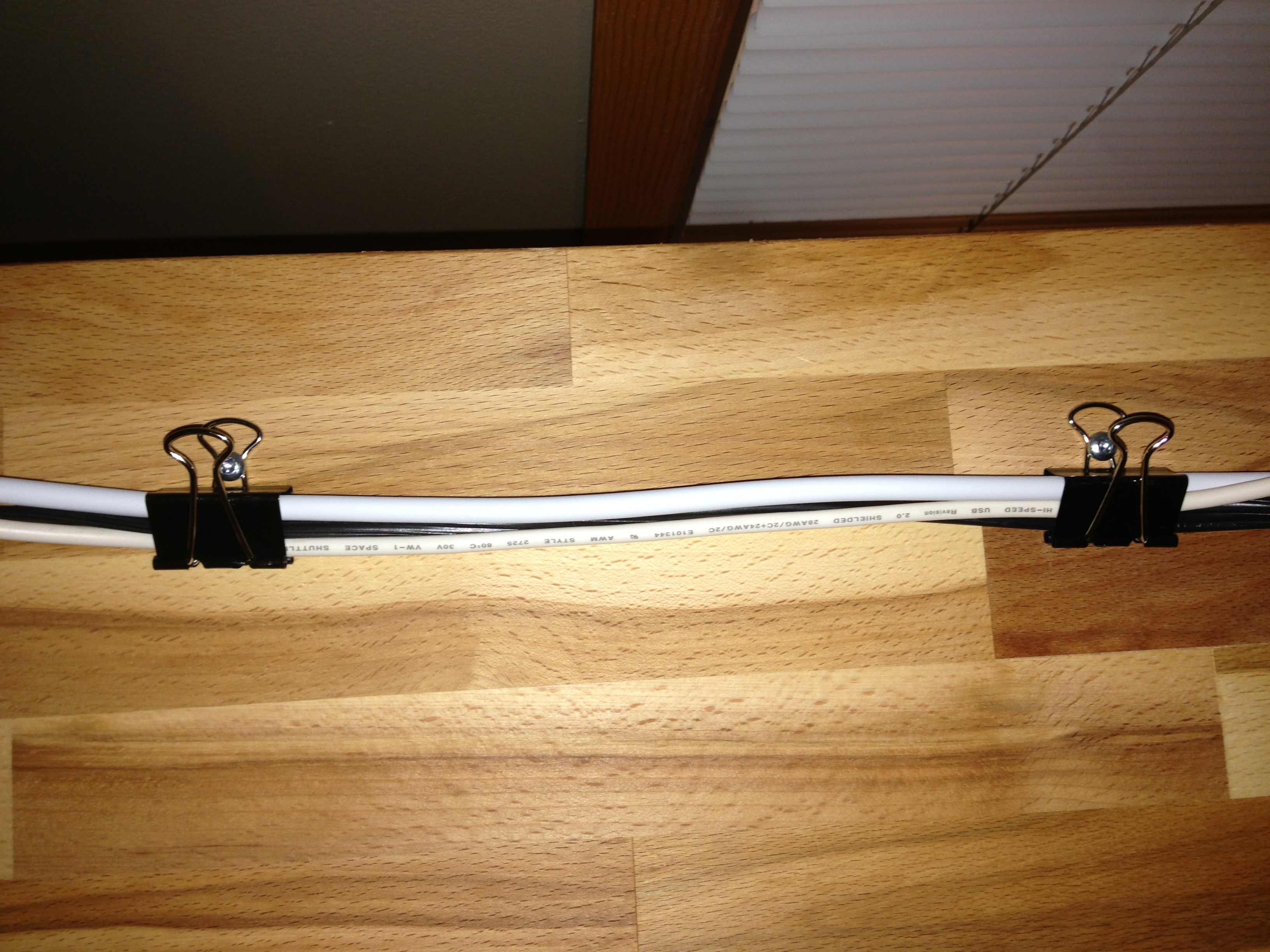
All cables, except the single power cord for the outlet hidden under the desk and the internet cable, are organized under the desk. As can be seen, I simply use medium size binder clip for quick cable arrangements, an idea found browsing the net. Cables can be removed and put back in the clip as easily as documents!

Desk3

Desk2

I also bought the IKEA cable outlet kit, which contains the necessary drilling tool and made three opening for cables at each end of the desk (one is right behind the computer) and one in the middle. Inserting the pass-through cable holder make a very nice finish. For the one in the middle, it is hidden by the rocks I brought back from Étretat, Northern France (see picture below).

Desk4

I also borrowed kitchen organizing tools from IKEA (love the practical side of the Sweden company), namely the magnetic rails for holding cables and containers for clips and others. The containers of course are also magnetize and fits (rather strongly actually) on the rail.

Desk5

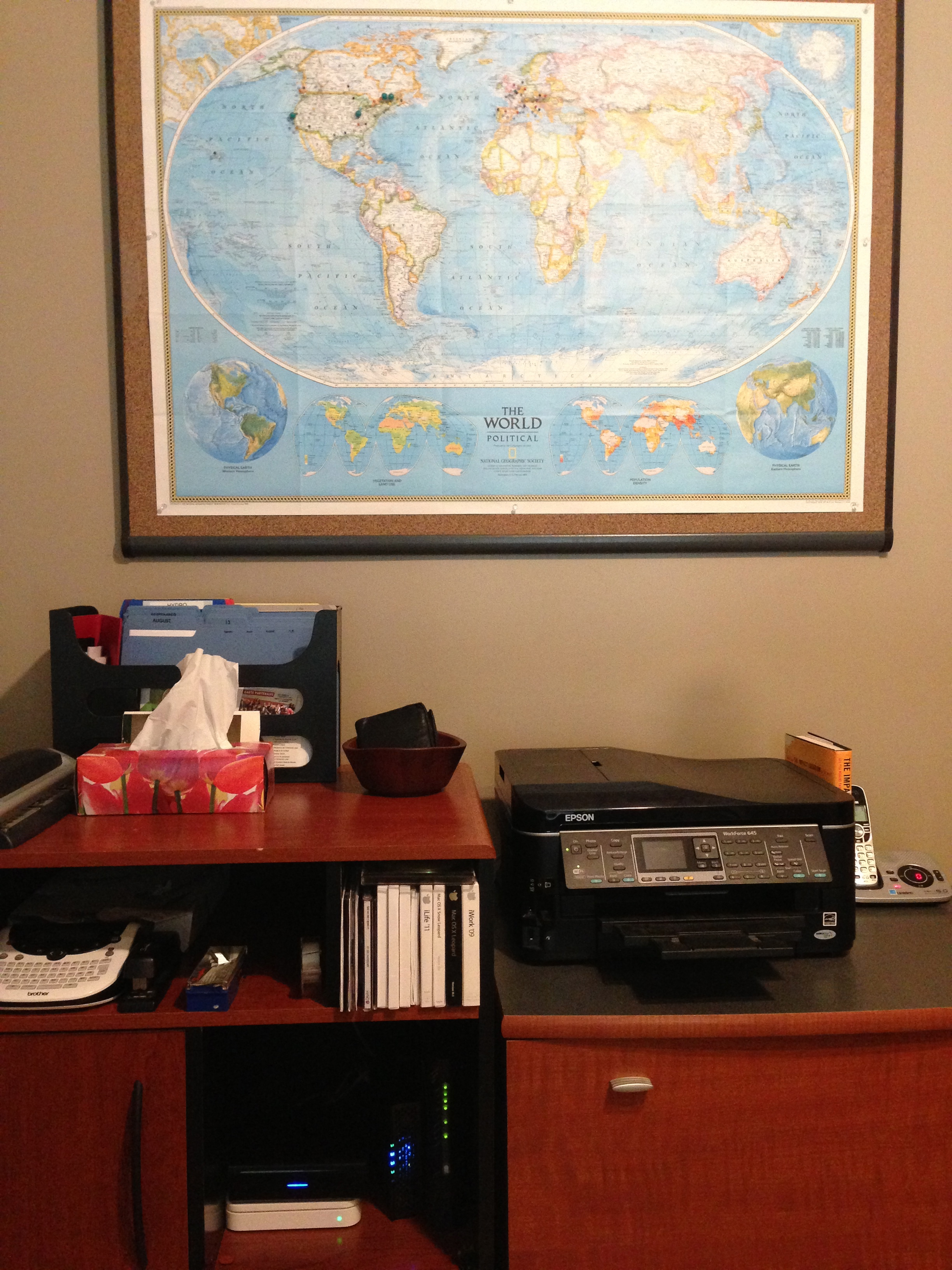
The home printer, Wi-Fi router and so on sit opposite to the desk.

Desk6

Desk7

According to this study, we scientists, do work way to much. So why not make your environment an interesting one (for you) !

Practice, practice, practice

“Practice is the best of all instructors”
Publilius Syrus (Roman author, 1st century B.C.)

Back from the AAPM scientific meeting, and kudos’ to the organizers for an excellent meeting. Over the past few years, they have set-up a “Best in” category regrouping the 5 highest scored abstracts in each 3 broad categories of the meeting. Not only do they get oral presentations but they also deserved a special poster viewing session. An extremely interesting and exciting session!

Continue reading

Big week at the 2013 AAPM meeting

Our group is well represented at this year AAPM meeting. 2 Faculty and 7 graduate students for a total of 11 oral presentations and 2 posters.

For a number of these students, it will be their first experience presenting at such a big event (over 3000 participants). Also for many of them, it will be their first scientific presentation in English. Hours of preparation and rehearsing for 5 minutes (snap oral) or 8 minutes (regular oral) presentations. While, I do tell them that the shorter the talk the more time (usually many hours!) is needed to select and organize the visual materials (aka slides), they do not realize it until we do the general repetition during our weekly group meeting.

For each talk, we can spend between 10 to 30 minutes going over the slides, suggesting modification, addition, removal, asking questions such as: what are you try to say? What is your main message? What do you want the audience to remember from this or that slide, …

Of course, senior grad students have it easier as they already know what to expect and prepare their presentations accordingly 😉

For my friends and colleagues in the medical field, see you in Indy.

Passionate peoples

What is it that drive peoples to want to give time, help others, teach, create, innovate, care, entertain, foster, always push boundaries, …, not once, but years after years. For most of these individuals, it seems to be a life long commitment.

If people knew how hard I worked to get my mastery, it wouldn’t seem so wonderful after all.

– Michelangelo

Why I am bringing this up. Well a few nights ago I went to an outdoor show with my daughter. Of course, the artist performing will make a lot of money but in this case it is obvious he doesn’t need it. Most artist come a few hours before the show, get the job done and go back. Usually, there will be another group present “to prepare the crowd.” They will play for 90 to 120 minutes with a pause in the middle and an encore included.

This particular individual got to the city the day before, took the time to discover the area, the food, the people. He made effort to get familiar with the language (not English!). Everywhere he goes, you hear stories about how accessible, gentle and caring he is.

So we are this show and this artist is playing for 130 minutes non-stop, no pause. 30 tunes in a row. He is 71 and clearly having fun, clearly caring that we are also having fun with him… 2 pause minutes and back for an Encore: 45 more minutes of musics!!!

I asked my daughter about the show, after all this is not music made in her generation. She was not only impressed, she was touched by artist, his behavior during the show (including an impromptu happy birthday song and hug on stage to a young girl waving a board since the beginning of the evening), his caring and giving. This is what passion is about: being 71, loving musics and coming to share it from 9h PM to midnight non-stop and having a party with the crowd. The guy is (Sir) Paul McCartney.

These individuals can of course be professional athletes, successful inventors, CEOs, stars but they are also nurse, teachers, researchers and much more.

Passionate peoples are first and foremost movers. They make things happen, they create magic for a child, a sick person, a student, a crowd… society. I do not know if the students I teach and those I supervise through graduate studies will remember me as a passionate person down the road. I certainly aspire at being better at doing it.