I recently came across the following document by Professor Alan M Johnson, which appears to be distributed freely by Elsevier and entitled “Charting a Course for a Successful Research Career: A Guide for Early Career Researchers – 2nd edition“.
Tag Archives: research
Research ethics, informed consent and Facebook
Yep, Facebook experimented with 700 000 of its users without their knowledge, and published their results in PNAS!
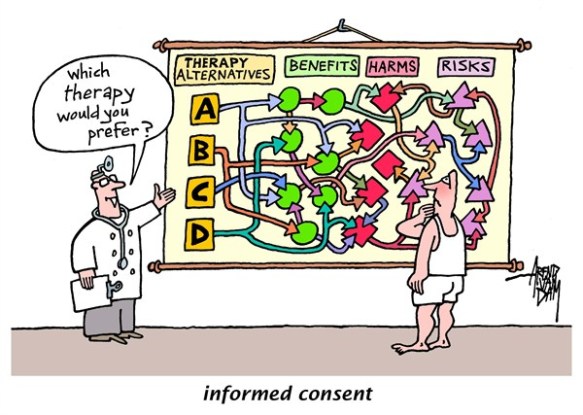
The general explanation: the users consent to anything and everything for the rest of their lives (Facebook lives) when they signed up to use the service. By that measure, every patient coming to our medical clinics agrees to be part of an experiment or trial and their data used for publication because they have agreed to be treated… OK, I am pushing the boundary a bit (maybe a lot) here but you get the picture and it is a bit absurd.
(* Cartoon from the Cagle Post by Arend van Dam)
However, this has lead to an interesting post on the concept of informed consent, which is at the heart of this kind of studies. It is an essential condition (but not the only one) to allow clinical or drug trials and robustly enforced by ethic committees, at least in the OCDE countries. While hospitals and physicians can use patient data for quality assurance purposes, publication of the said data cannot be made without the patient informed consent.
This could be a great general public education opportunity.
3D printing, the ultimate gadget for grown-up kids
“Tea. Earl Grey. Hot” — Picard in ST:TNG

…Oops in the title, I meant serious scientists, of course 😉 The first time I saw a 3D printer under 10000$ in action, I told myself they were right again, “they” meaning Star Trek.
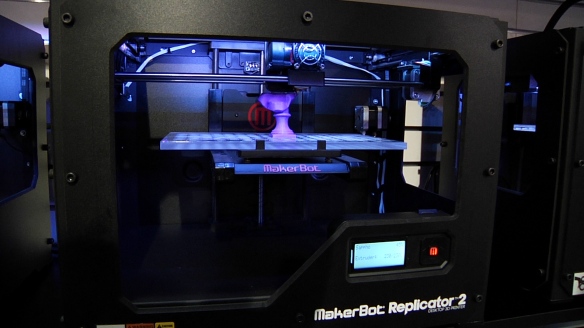
Almost a year ago, we bought a MakerBot Replicator 2 for our research group. Our interest was to be able to do fast prototyping, quickly create small pieces, adaptors and so on. It certainly change the way approach our laboratory experiments, more importantly we do not have to go to machine shop until we have a much better idea of what work and what doesn’t. We were even able to start exploring way 3D printing could change one our field of applications (brachytherapy, if you need to know!). We also found out that printing with PLA resulted in much more sturdy and better print quality than ABS plastic.
3D printing is a game changer not only in scientific research and engineering but also in medicine, where application in dentistry and organ printing, liver was even predicted in 2014! Of course you can find this great talk about 3D printing and airplane or 3D printing in space.
However, 3D printing will become mainstream technology very quickly. Already, cheap 3D printers can be bought in Staples. The biggest news, to me, is that public libraries are about to make3D printing accessible to… the public. The Toronto public library has made such announcement recently: 5 cents a minute, maximum of 2 hours of printing time. Of course, this bring a fairly good number of questions regarding intellectual properties. For instance, you could print your own Lego-like blocks at home; the raw material costs about 40$ per Kg. If you type in Google “3D printer and IP”, you will get thousands of hits.
If you need a good primer on 3D printing technology, Wikipedia has a very nice one.

Massive Open Online Course (MOOC) in Scientific Writing
Want to get better and more effective at writing scientific manuscripts? Stanford is hosting a free MOOC course on the topic. The content look very interesting:
Are you at an exciting phase of your thesis project?
If we knew what it was we were doing, it would not be called research, would it?
– Albert Einstein
How do you know for sure that you are at a particularly interesting stage of your thesis project?
When the excitement spread to your supervisor, fellow students and the extended team (collaborators and others). When you present at a meeting and peoples come talk to you with that look in their eyes. When you are asked by scientists or other students unrelated to your project if you have published/submitted your results.
The flip side of that coin is that the pressure is on you (and your supervisor) to convert in a timely fashion to peer-reviewed publications 😉
Big week at the 2013 AAPM meeting
Our group is well represented at this year AAPM meeting. 2 Faculty and 7 graduate students for a total of 11 oral presentations and 2 posters.
For a number of these students, it will be their first experience presenting at such a big event (over 3000 participants). Also for many of them, it will be their first scientific presentation in English. Hours of preparation and rehearsing for 5 minutes (snap oral) or 8 minutes (regular oral) presentations. While, I do tell them that the shorter the talk the more time (usually many hours!) is needed to select and organize the visual materials (aka slides), they do not realize it until we do the general repetition during our weekly group meeting.
For each talk, we can spend between 10 to 30 minutes going over the slides, suggesting modification, addition, removal, asking questions such as: what are you try to say? What is your main message? What do you want the audience to remember from this or that slide, …
Of course, senior grad students have it easier as they already know what to expect and prepare their presentations accordingly 😉
For my friends and colleagues in the medical field, see you in Indy.