Human-computer interaction took a dramatic turn 30 years ago

Let’s go invent tomorrow instead of worrying about what happened yesterday.

– Steve Jobs

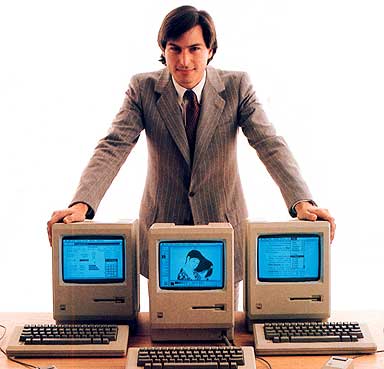
The release of the first Graphical User Interface or GUI for the masses happen on January 24th 1984 when Apple release the Macintosh. It deeply changes the face of the computer industry and how we interact with them.

jobs1984

In 1985, our school dumped its old language lab (with tape players) for a network of Macintosh. That same school year, we did a fully digital school year book of the 1985-1986 graduates. Photos were actually scanned using a manual B&W scanner . All texts and final page preparations were done on the Mac! It took years to replicate any of this on another platform, replicate what was done with such facility by a bunch of teenagers. A few years later at the University, one of the major student journals, using a “specialized” DOS program called Ventura Publishing, was still not able to do true WYSIWYG publications.

Of course the famous 1984 commercial, By Ridley Scott(!), also became one of the best commercial ever produced. You can also find the Steve Jobs’ Mac introduction to the world video.

At the time, I had gone through the very beginning of the general public personal computing first hand with the TRS-80, Apple IIe, Vic 20 and Commodore 64. But what we did with the school Macs was, for the time, really exceptional. It was obvious to me that this was the future of the PC. I went on to work on mainframes and UNIX-based workstations (SUNOS and Solaris, HP AUX, Linux, …) for most of my early researcher career. But OSX changed everything again, no more secondary Linux box necessary, I could have everything on a single platform: the best of both world. In that, Steve Jobs’ NEXT Computer was really the next step… The NEXT computer was to play a role in the development of the World Wide Web!

Getting your Inbox to zero quickly and easily with MailHub, an “AI” add-on to Apple Mail!

There are numerous tools and recipes to help you get your e-mail Inbox to zero. One popular choice is indev MailTag and MailActOn. The nice things about indev software is that they plugged right in Apple Mail. Mail Act On is very powerful but requires you to build and maintain all the rules or act on “actions” you create. Also like its use for files, tagging does have limits, in particular when you have a large number of them: it simply does not scale easily. Finally using the combination of MailTag and MailActOn to deal with and file e-mails is not highly efficient when compared the way I am filing my load of weekly digital documents using DevonThink built-in Artificial Intelligence (AI).

One option would be to throw all of your e-mails in DevonThink but Devon is not a Mail program. I also like having e-mails from all of my on-going projects live on the corporate (University) server: accessible everywhere and backup for me!

Here comes Dervish Software MailHub to the rescue. MailHub is a plug-in to Apple Mail that adds intelligent “DevonThink like” filing capability to all of your mailboxes. When I say all mailboxes I really means for all that you asked MailHub to index: Work computer, Exchange/IMAP mailboxes, local mailboxes (I do have over 20 years of e-mail archives of the projects I completed over the years), iCloud and GMAIL. No time spent to create rules or actions, no upkeep “cost”. To be fair it does more than that but the intelligent filing with either a single keyboard shortcut or a single click (you have the choice and the keyboard shortcut is user configurable) is what sold me.

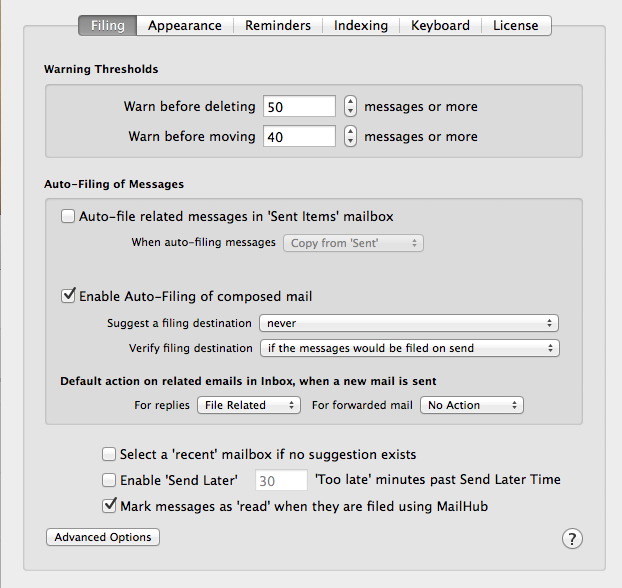
Mailhub1

Figure 1 and 2: MailHub addition to Apple Mail preference pane (above) and its options (below)

MailHub2

According to the website, here is a list of what is possible to do:

  • Organise your email simply and easily using MailHub’s auto-suggest intelligent technology which suggests where to file your mail based on your previous email activity
  • File or delete emails individually, by thread or by sender in one simple process
  • Auto-file sent email to its parent mailbox
  • Create new mailboxes simply and organically when new filing categories arise
  • Set reminders for email related actions at the touch of a button
  • Preview changes before making them / undo changes as required

I will not go through MailHub option tabs as shown in the previous figure. Once you have MailHub install you will notice that Apple Mail now have a new toolbar. I set mine to blue (it is one of the appearance option) in the figure below so you can clearly see it. The most used button is indicated by the black circle. Clicking on it will automatically filed the current e-mail in the mailbox indicated by the black rectangle. Again that mailbox can be local or on a remote server depending on your indexing option. I set MailHub so that all mailboxes, local and server-based, are indexed.

MailHub3

Figure 3: New toolbar to Apple Mail.

If you do not like the filling option (mailbox choice) provided to you by MailHub (black rectangle in the above figure), you can 1) click on the pull down menu to get other choices. This is similar to DevonThink that provides you with its best guest on the top and other choices below it. 2) You can also type in a few letters of a mailbox name in the search bar that will appear at the top of the pull down menu to bring a mailbox to the top. 3) You can also create a new mailbox using the + button shown in the back rectangle region of the above figure. Notice also the arrow, it allows you to automatically jump to the selected mailbox and the home button (green circle) get you back to your Inbox.

Now you probably have picked up that the filling button, indicated by the black circle, also has a pull down menu. This is because you can file the current e-mail, file the entire e-mail thread or all e-mail sent by this specific sender. The delete button beside it (between the black and the red circles) have the same options i.e. selected, thread or sender.

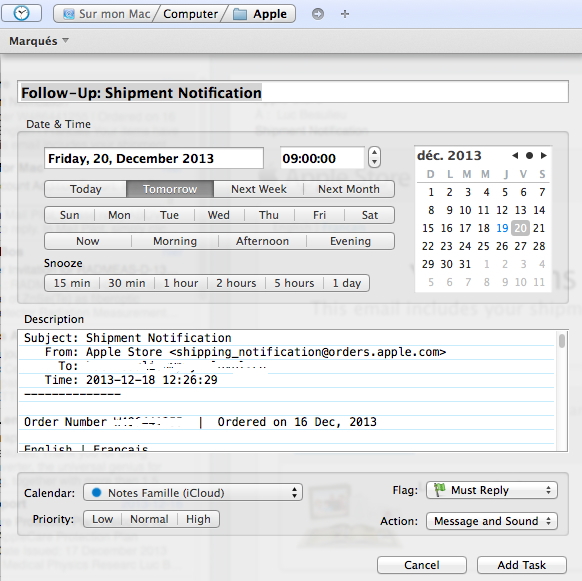
In the red circle, the little clock icon represent reminder options to be set on the selected e-mail. The available options are given in the figure below. It works with Reminder and iCal to set reminders at specific dates and times. An interesting feature is that the complete e-mail content is copied in the reminder  as a note. I set it so that the reminder is capture automatically by Things. It works flawlessly. The only major shortcoming to this is that a link back to the e-mail is not provided.I hope that this option is added by Dervish Software in a future release. As such, for now I much prefer using Things keyboard shortcut to create a quick entry in Things that does contain the link back to the e-mailing question.

MailHub4

Figure 4: MailHub reminder options, including setting flags, action and iCal/Reminder.

You will also notice a new toolbar addition when you write a new e-mail or reply to an existing one. This time you have three “send” mail options, the regular one (original top left icon = third button from the left on the new toolbar – Figure below) and two new options: 1) send e-mail and file the sent message (you get to set which mailbox using the pull down menu (“none set” in the image below) or 2) send e-mail and deleted the sent message. I really like the “send and file” option. For many e-mail threads I like to keep copy of my sent messages. This option allow you to skip CCing myself and then file that message: saving further e-mail processing (or taking manually the sent messages and file them, which would also take extra e-mail processing time). You will also notice the clock icon for setting reminder related to the e-mail you are about to send. This gives you the exact same options as explained before.

MailHub5 NewMail add on

Figure 5: New post/reply to existing post MailHub toolbar add-ons.

You can download and use MailHub free (full feature sets) for 30 days. I was sold after two days but mileage will vary. Conclusion, 19$ very well spent and, at least for me, much more efficient and cheaper that the combination MailTag and MailActOn. Getting my Inbox to zero has never been so quick and easy, especially when combined with SaneBox (that automatically sort close to 40% of my incoming e-mails out of my Inbox without any action on my part!).

Happy New Year!

Why not give (productivity) software this year!

pro·duc·tiv·i·ty  (prdk-tv-t, prdk-)

n.

1. The quality of being productive.
2. Economics The rate at which goods or services are produced especially output per unit of labor.
3. Ecology The rate at which radiant energy is used by producers to form organic substances as food for consumers.

Why not give yourself or a love one access to well design software? With the new years usually comes the time to take resolution(s). And like most they are forgotten a few weeks later.  This is because, we human being, get our attention so easily put elsewhere, diverted by what surround us, in particular the consumption media. So, we tend to get into an unproductive state by putting off what must or should be done. Simply stated procrastinating.

pro·cras·ti·nate  (pr-krst-nt, pr-)

v. pro·cras·ti·nat·edpro·cras·ti·nat·ingpro·cras·ti·nates
v.intr.

To put off doing something, especially out of habitual carelessness or laziness.

v.tr.

To postpone or delay needlessly.
It turns out that having tools that you like to use because of its physical design (an iMac, a Mac Book air or even the new Mac Pro!), the feeling it provide when touching it (like a well-made pen or paper notebook) and well design software all help in getting things done. There are many reasons why certain tools, hardware or software give use incentive to be productive over others or make us more productive. The important point is that you have to use them, use them everyday and actually like to do it.
The first rule in being productive is to actually do something. The second rule is for that something to actually be part of a whole that get your projects moving forward. This implicitly means that you can track your projects, the tasks associated with them and the necessary documents (files, e-mail, …). If you hate the software and hardware your are using to do this or they get in the way because they are not well conceive, you will loose interest, loose track of the important stuff and suddenly the not so important stuff become at the forefront of what you are doing.
Here are a few well design software you might want to invest into (some are actually free) and that are available to OSX and iOS:
  • Professional digital document management: DevonThink Pro Office and DevonThink To Go. On the Mac, you have indexing and AI doing automatic filing for you. No need for Tags. Tagging is a good concept but it does not scale and its efficiency certainly breaks down once you have tens of thousands of files.
  • Note taking app: Evernote (free) or NoteBook. I also find Apple Notes useful since it is always with me on my Mac, iPhone and iPad.
  • Task manager: Wunderlist (free – perfect for student and much better than Apple Reminder) or professional grade Cultured Code Things and OmniFocus.
  • MindMapping software: XMind (free) and iThoughts (Nice interface, intuitive to use, my favorite).
  • Project management (for large projects): Merlin and OmniPlan.
  • PDF management and citation software: Papers 2 (stay away from the “new” Papers 3), Sente or Zetero (free).

Some software should also allow you to get stuff done so you do not have to. In that category, I could not live in the digital world without:

  • 1Password: Strong passwords for all for all of your accounts, safely stored using the best encryption scheme. Never loose time again with passwords.
  • SaneBox: Made me realize that over 40% of my incoming e-mails are non actionable. SaneBox get them out of the way automatically for me. I never thought I would say this (I work with e-mail since 1991!!!), but 5$/month well spent. Work with IMAP, Exchange, iCloud, GMAIL.
  • MacUpdate Desktop: Unless you get all of your software from the Apple Store on OSX, you need to track your software and keep them up to date. MacUpdate does this for you very efficiently. Run it once a month, no sweat.
  • Alfred: Spotlight on steroid!
Merry Xmas!

Cultured Code Things 3 on the way for 2014!

The team at Cultured Code has announced on their blog that they have reached 1 million copies of Things  sold. In the same blog post, they let us know that version 3 of Things will be coming in 2014. Hopefully it will not know that same fate as the cloud sync version of Things which took over two years after the first announcement…

Attachment-1

Things is powerful task manager. It comes with a simple and efficient interface and is fully scriptable (Apple Script). I have been using Things since its very first beta release. Certainly look forward to V3.

What is going on at Mekentosj with Papers 3?

Having a PDF management system, which allows in-app citation (e.g. WORD, Pages, Mellel, …), is a necessity for scientists and researchers. On OSX, we have the chance of having the choice between extremely well-design and efficient applications such as Sente, Mendeley and yes, Papers (there are of course free options, as always it depends how much time you want to spend working with your tools relative to working on your tools!).

 In the past I have used Endnote, Zotero, Sente and finally settled for Papers starting at version 2.0.8 for its extremely well thought-of citation mechanisms, PF editing options and nice interface. A review is available here in the e-office series.

Zoom to the latest version (still a beta) of Papers. Yes the interface changed quite a lot, both on OSX and iOS. Mekentosj seems to have adopted the design element of iOS 7 as a reference across the board. Quite frankly, the only thing I do not like in iOS 7 is the color scheme used for certain icons. Otherwise, I like it very much: it is clean, simple, introduced great new stuffs and does not get in the way. 

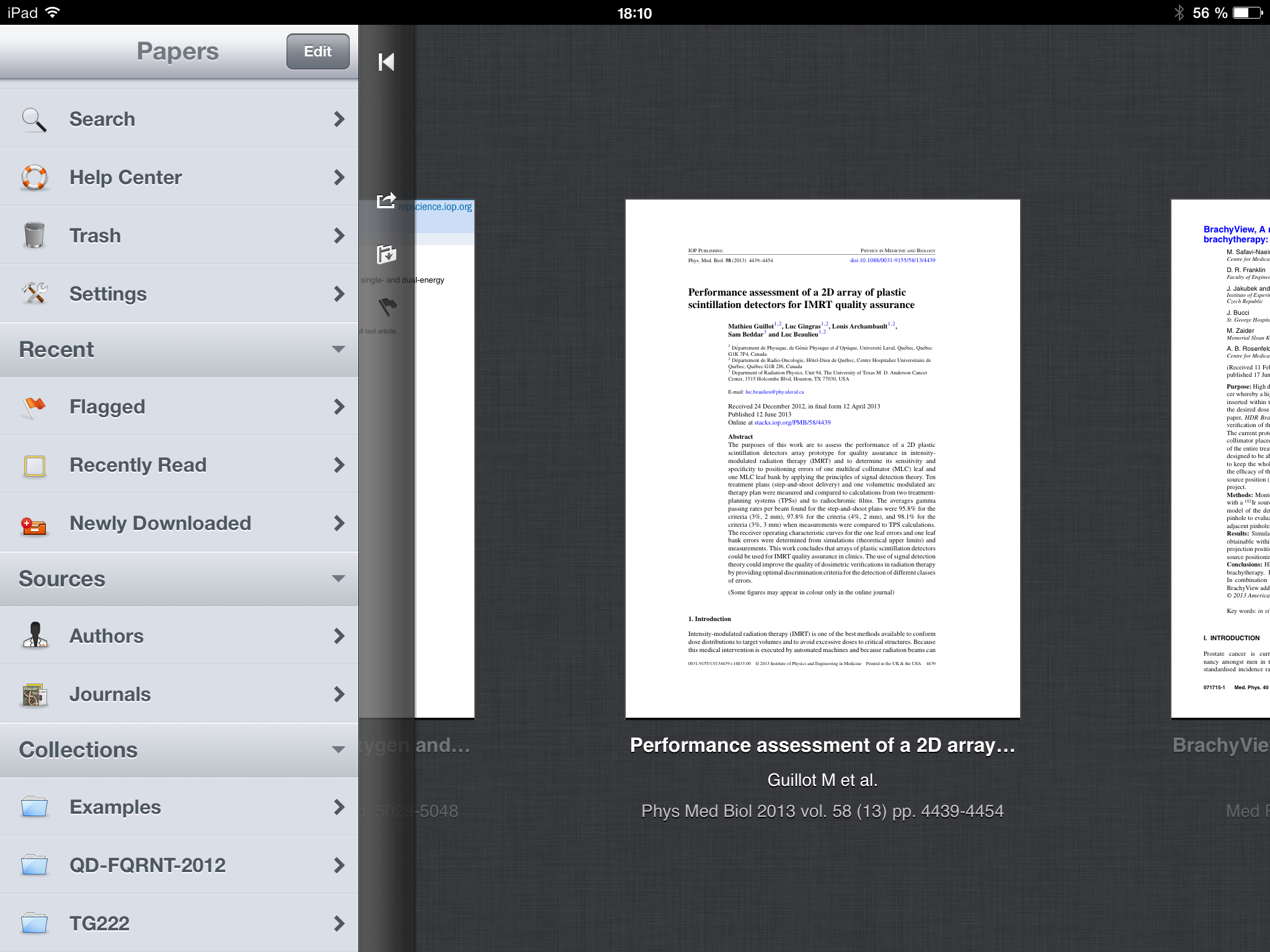
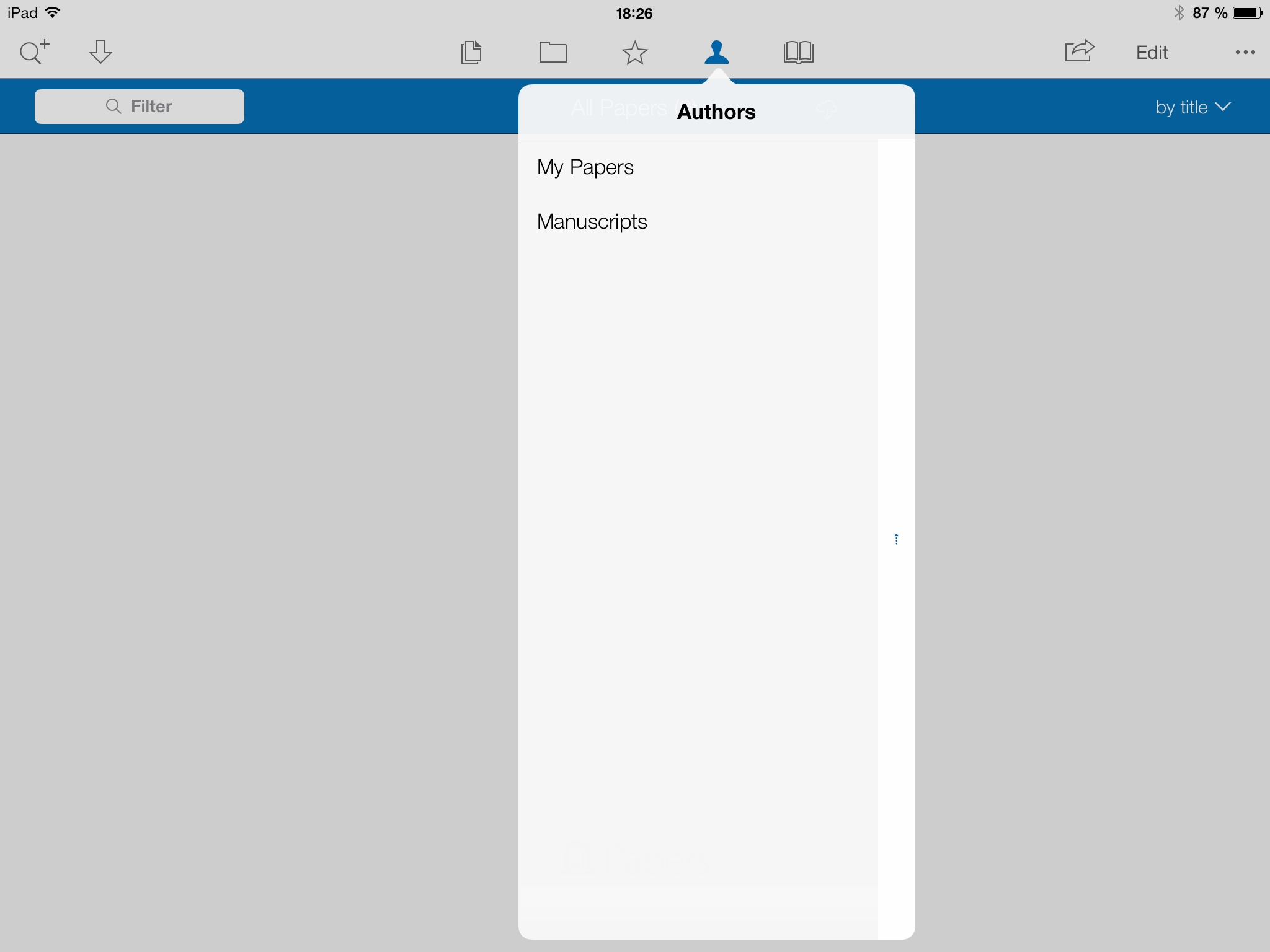
Below are the screen captures for iOS version of Papers and Papers3. 

Papers-iOS

Papers3-iOS

So, you say great this guy love Papers 3. Not at all. Design change you can get use to it (assuming it is for the better) but key missing feature is a problem.

Papers 3 allow syncing via DropBox or import/export of the whole library…Gone is the great WiFi sync of the previous version. Why it is this important? My library is large, closing in 5 Gb. I do not want to put that on DropBox (or on any servers for that matter) nor do I need to have all of that in the Cloud. The DropxBox options look interesting for a small library but for large libraries I am not convince and I feel it is unnecessary to pay for cloud storage space to store my library (this is why I do not like Mendeley for example). Even my library at close to 5 Gb is not that large and only contains over 4000 entries.

When I ask Mekentosj about it, I received the following from the support staff:

Hi there

Thank you for your feedback regarding this. I’m afraid that Dropbox is the only solution at the moment. However, we hope to include a possibility to sync via Wi-Fi in some point as well. However, depending on the technical aspects and Papers release cycle, it’s hard to know yet when that’s going to happen, so please be patient

So it might or might not happen in the future. For now, I would think that this is a big deal for users with large libraries. I reverted back to Papers2 like a number of my colleagues.

Overall, very disappointing first contact with Papers 3


NOTE: Academic workflow on Mac also has a coverage of Papers 3 which describes other important issues

OSX 10.9 (Mavericks) is available and free!

Wired is running an interesting piece about the latest operating system from Apple. In part past, Apple provided free or very low cost upgrade for its “minor” version of OSX but paying upgrade for significant new version. 10.9 is a significant upgrade but will be free: Apple Just Ended the Era of Paid Operating Systems | Wired Business | Wired.com.

In a related news, iWork (Numbers, Keynote and Page) will be free with each new Apple computing devices, Mac or iDevices! Office productivity and MS Office compatibility out of the box. That should be interesting…