64bits A7/A8 chips: the biggest smartphone technological innovation over the last two years

For some peoples, trivial increase in screen size is what they call innovation. Of course, it is the first things you see but unless there is a significant new underlying technology, making something bigger is a bit trivial. At that rate, we will be talking with 10 and 12 inches phablet to our ears in a few years and call it innovation, instead of stupidity.

No, the biggest technological innovation is unseen to the naked eye: the lower power, high performance custom made 64bits A7 and A8  chips. I wouldn’t be surprise to discover some design genius also in the S1 chip for the Apple watch also (which in itself might be more exciting than the rest of the watch) but will have to wait a few more months.

Apple_A8_system-on-a-chip

2 billions transistors. That is the transistors count of the new 64 bits A8 chips Apple put in its latest smartphone.

Two billion transistors represents about the 2010 Quad-Core Itanuim counts, while the latest Haswell chips has about 1.4 billions transistors (without the GPU). Of course in the A8 this number is for the dual-core CPU and the integrated GPU (6 clusters) units.

Geekbench 3 benchmark scores

The top of the line 3.5GHz i7-4471 64 bits chip score 3914 for single core of  while the A8 gives around 1630 at 1.4GHz (also single core). Interestingly, this give more power per GHz (if such a metric is meaningful). Note that such a score is also equivalent to the 2009 3GHz Core 2 Duo T9900 found in MacBook Pro and iMac of that time… only 5 years back. Also, current MacBook Air scores about 2200 for single core. On the graphic side, the hexa-core Series 6XT GX6650 GPU is around or above 250 GFLOPSs, which would put it in the same class as a GeForce GT 620. The A8 chip is indeed a desktop class chip, if only a few years behind 😉

The iPhone 6 with the A8 does not have the largest numbers in term of GHz, # of CPU core and processor speed; the competition have numbers ranging from factor or 2 to 3 higher in those categories(!). As with anything, higher numbers do not always means better performance or a more efficient device. Yet, the iPhone 6 still ranks best in the class in some benchmarks and in the top contender spots in most categories (expect the benchmark heavily dependent on multicore such as the physics test). This makes it an overall top performer despite having only a 1.4 Ghz dual core chip and despite having only 1 Gb of RAM…

Even more interesting, and certainly part of the excitement for the underlying technologies part of the iPhone 6, is the battery life. Again, the iPhone is not the best but still performing very good in these tests. It does so however with some of the smallest batteries on the market (only 1810 mAh for the iPhone 6). As such, the “talk-time” or “on time” per mAh is by a large margin better for Apple hardware than the competition for similar or better computing performance; Apple obviously prefer smaller phone thickness (which the A-series chips power/performance ratio allow Apple to do) to larger batteries. This option is simply not available to the competition without either seriously impacting “talk time” or decreasing the specs to abysmal level.

In short, the A8 64 bits chip is a truly amazing overall design engineering feat but also telling is the other part of the equation: the extremely efficient underpinning UNIX system (iOS is a derivative of OSX after all) and to some extent much better apps programming to fit within the RAM space and still outperform the competition in usability. This is true innovation, not screen size and the like. At this point, the performance gap between the iPhone 6 and a MacBook Air appears to be roughly 40-50% (based on Geekbench 3 scores). Convergence of computing power between ultraportable notebook, smartphone and other portable devices is almost a reality with the very low power chips.

Again, it is going to be interesting to see what the internal of the Apple Watch is really made of. The internal, that is the S1 chip but also the new haptic interface, might very well be the true innovation in what would otherwise be simply another fitness gadget.

Taking a clear stance on digital privacy…

A few years ago, users of Internet services began to realize that when an online service is free, you’re not the customer. You’re the product. But at Apple, we believe a great customer experience shouldn’t come at the expense of your privacy.

Our business model is very straightforward: We sell great products. We don’t build a profile based on your email content or web browsing habits to sell to advertisers. We don’t “monetize” the information you store on your iPhone or in iCloud. And we don’t read your email or your messages to get information to market to you. Our software and services are designed to make our devices better. Plain and simple.

– Tim Cook (View the whole text: Apple – Privacy.)


Only a company that make that much money selling hardware could take this stands: Google, Amazon, Facebook and the others simply cannot afford such commitment… and it is not their business model. You are their business model, you are their product!

5 years and still going!

While the frenzy is going on today for the iPhone 6, our venerable 3GS is still functioning perfectly after its 5th “birthday”! A small break on the screen but iOS6 still look good and still allow for the key functions (web, social networks, email, iMessage/SMS, contact, calendar and, of course, phone). Perfect secondary cellphone for our house.


IMG_2883

Roam Mobility: a cell phone solution for Canadian traveling to the USA!

In Canada, we are stuck with some of the worst (read most expensive) cell phone plans of the OCDE countries (see also Michael Geist Blog).
Things are even worst if you travel abroad with your cell phone and keep your current provider of service: welcome to the wonderful world of roaming charges. Here is are things look as of June 7th 2014:
Bell: Roaming charges 1.45$/min, 6$/Mb and 0.75$/text or pay 20$ for 100Mb or 50$ for 500Mb and so on
Rogers : Packages consisting of 40$ for 50 min, 200 Mb of data / 80$ for 100 min and 500 Mb of data.
Similar fees can be obtained for other Canadian providers.
RoamMobility
Recently found the solution to this, let’s call it, problem: Vancouver-based Roam Mobility . You can get a Sim Card from Roam Mobility that gives you a “permanent” USA phone number and nice roaming prices and options:
  • Unlimited nationwide talk
  • Unlimited global text
  • Unthrottled high-speed data
  • Free long-distance calls to Canada (yes!)
  • Voicemail and caller ID
So, how does it work? You either buy you Sim Card directly from Roam Mobility or, as I did, in a Staples store (“Bureau en Gros” in Quebec). When you register your Sim Card on Roam Mobility web site, you are attributed a USA phone number that will be valid as long as you use the service once per year. You than chose a package for 1, 3, 7, 14 or 30 days (there is also an option for those who have longer stay)
  • Data only
  • Text and talk
  • Text, talk and data
Once you pick your plan, you also chose online your activation data and time. For my part, I picked the landing time of my flight. So the only thing you have to do is to change your Canadian Sim Card to the Roam Mobility Sim Card (assuming that your phone, like mine, is unlock). Note, you need to carry the Sim Card holder opener tool (or a small paper clip). If you never change your phone Sim Card, there are ample instruction on YouTube. Here is the one for the iPhone5/5s. Changing the Sim Card takes only a few seconds; no need to shutdown your phone.
Once done, change the APN to roam (no password) and that’s it, your ready to go. On IOS 7, this is what the previous link will tell you to do:
  • Select Settings
  • Select Cellular
  • Select Cellular Data Network
  • Under the Cellular Data section change the APN to the word roam(Username & Password should be blank)
  • Scroll down and under the Personal Hotspot section change the APN to the word roam (Username & Password should be blank)
  • Save the setting and restart your phone

If this is the first time you use you card, you will be walked through the setting of your USA voice mail once your phone is activated at destination. No your Roam Mobility Sim Card does not work within Canada 😦

The plans are 3.95$ for 1 day (300Mb of data), 11,95 for 3 days (900Mb of data), 27,95 for 7 days (2Gb of data included), … And yes you can share your data with your iPad or computer. This is a fraction of the cost charged by our Canadian providers for roaming charges or “travel packages”.

Plans

It worked flawlessly and when landing in Canada, simply put your Canadian Sim back in the phone and store you Roam Mobility card for your next trips.

Brilliant 😉

P.S.: Roaming Sim Card and packages are even less expansive in Europe. I’ve tried Austria and Belgium up to now. So if you travel even moderately, paying up front you cell phone and having it unlock gives you access to very good deals outside the country.


3D printing, the ultimate gadget for grown-up kids

“Tea. Earl Grey. Hot” — Picard in ST:TNG

star-trek-replicator

…Oops in the title, I meant serious scientists, of course 😉 The first time I saw a 3D printer under 10000$ in action, I told myself they were right again, “they” meaning Star Trek.

Almost a year ago, we bought a MakerBot Replicator 2 for our research group. Our interest was to be able to do fast prototyping, quickly create small pieces, adaptors and so on. It certainly change the way approach our laboratory experiments, more importantly we do not have to go to machine shop until we have a much better idea of what work and what doesn’t. We were even able to start exploring way 3D printing could change one our field of applications (brachytherapy, if you need to know!). We also found out that printing with PLA resulted in much more sturdy and better print quality than ABS plastic.

file_202807_0_CES2013-MakerBot01

3D printing is a game changer not only in scientific research and engineering but also in medicine, where application in dentistry and organ printing, liver was even predicted in 2014! Of course you can find this great talk about 3D printing and airplane or 3D printing in space.

However, 3D printing will become mainstream technology very quickly. Already, cheap 3D printers can be bought in Staples. The biggest news, to me, is that public libraries are about to make3D printing accessible to… the public. The Toronto public library has made such announcement recently: 5 cents a minute, maximum of 2 hours of printing time. Of course, this bring a fairly good number of questions regarding intellectual properties. For instance, you could print your own Lego-like blocks at home; the raw material costs about 40$ per Kg. If you type in Google “3D printer and IP”, you will get thousands of hits.

If you need a good primer on 3D printing technology, Wikipedia has a very nice one.

Smartphone camera can be used as a radiation monitor

Your smartphone is closer to a Star Trek tricorder than you may think!

Smartphones have really become portable, and wearable, computing devices. They can process loads of data, do real-time tracking (through GPS) and various motion tracking via integrated multi-axis sensors. Increasingly, auxiliary devices can also be attached and link to via Bluetooth 4.0. A group of researchers has recently demonstrated that the CMOS at the heart of the integrated camera of smartphones can be used as radiation detection monitors!

Dose-rate

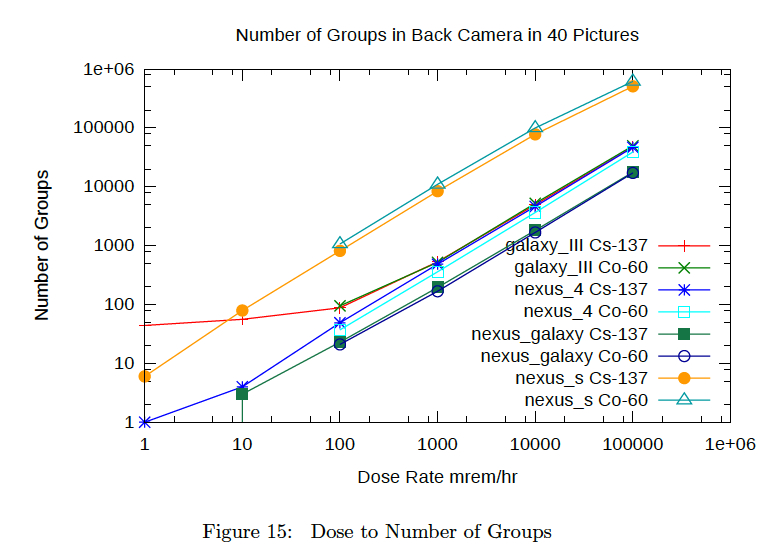
A recent paper by Joshua J. Cogliati, Kurt W. Derr, Jayson Wharton entitled “Using CMOS Sensors in a Cellphone for Gamma Detection and Classification”, and freely available on arXive, is demonstrating this of high energy gamma radiation and various Samsung. The idea is that when high energy photons (gamma radiations) hit the sensors, it generate high energy electrons that will leave fire the CMOS (or CCD) pixels that would otherwise have no signals. The produce “tracks” and the numbers of these tracks are representative of the amount of radiation measured by the device. This is shown on the figure above, Fig. 15 of that manuscript.

Beam me up Scotty!