
Opportunités MSc-PhD CAMPEP en Physique Médicale

Multiples ouvertures pour des projets de 2e (maitrise) et 3e cycle (PhD) portant sur des applications de concepts de physique, de génie et des méthodes numériques à la médecine dans le cadre de notre programme CAMPEP en physique médicale. Venez vous joindre à une équipe inclusive et diverse de plus de 25 personnes étudiantes et stagiaires postdoctoraux, et 24 physicien.ne.s médicaux. Vous aurez accès à de multiples plateformes de hautes technologies modernes (incluant un IRM-Linac), un milieu dynamique et interdisciplinaire avec de nombreuses occasions de présentations, collaborations et réseautage au niveau local, national et international. Une grande latitude vous sera accordée pour développer diverses compétences professionnelles selon vos objectifs.

Nous recherchons des personnes qui ont complété un diplôme de 1er cycle universitaire en physique ou génie physique, ayant une moyenne minimum de B ou l’équivalent. De plus, les qualités suivantes seront considérées comme des atouts :

  • Un intérêt démontré pour la science expérimentale ou la science numérique.
  • Une maîtrise des outils d’analyse numérique (Python, C/C++, etc.).
  • Un bon niveau d’autonomie.
  • Le désir de travailler dans un environnement multidisciplinaire.

Pour postuler, remplir ce formulaire en ligne https://forms.office.com/r/GHek4JTt8G : vous y déposerez un seul fichier PDF incluant dans l’ordre : 1) une lettre de motivation expliquant votre parcours avec les défis que vous avez relevés et vos intérêts de recherche (type de projet, sujets, etc.), 2) un CV et 3) tous vos relevés de notes de niveau universitaire. Pour questions : luc[dot]beaulieu@phy[dot]ulaval[dot]ca. Nous accepterons les candidatures jusqu’au 18 octobre 2024.

*Pour les personnes éligibles désirant postuler aux concours de bourses du CRSNG et FRQ de l’automne, il nous fera plaisir de vous parrainer. Dans ce cas, s.v.p. contactez-nous directement le plus rapidement possible et avant le 24 septembre (pour respecter les limites des organismes).

** Note that our CAMPEP graduate program is a French speaking program. While the research section can be conducted in English, teaching and interaction with the clinical staff are conducted in French and the willingness to acquire a basic proficiency in French is mandatory.
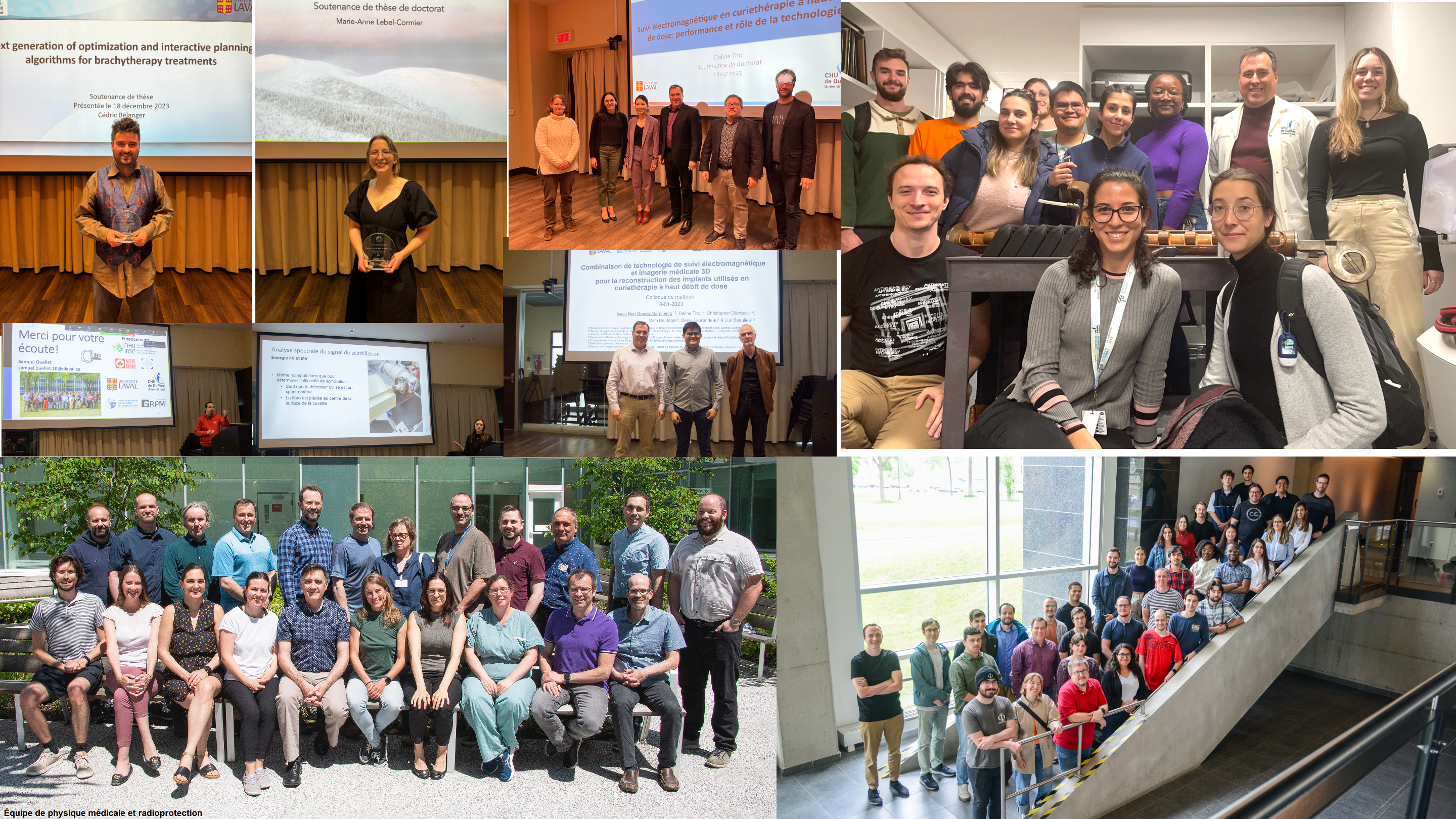
Looking back at our 2023 Medical Physics Program

“In looking back, I see nothing to regret and little to correct.” 
John C. Calhoun

2023 was a spectacular year for our CAMPEP medical physics graduate program. We have graduated a record number of 13 students, 4 PhD and 9 masters (a few photos of PhD thesis defenses and master colloquium are given below). The majority in both categories were women, by the way. 

From 2011, the first year of accreditation, to 2018, only two out of 16 PhD graduates were women while master graduates were about 50-50. In the last 5 years, 8 out of 11 PhD graduates were women.  This year, the radiation physics graduate course was the most diverse ever with students from 6 countries and, for two of the last three years, a majority of women (cf. top right photo)!

This is interesting on many fronts. First, as a program sitting in the Faculty of Sciences and Engineering (we are part of the physics and physics engineering department), Medical Physics standout for being a diverse, inclusive and welcoming environment for graduate students. At the same time, it is recognized to be a tougher program than a regular physics master program due to its enhanced course curriculum combined to the same research requirement. Second, Quebec City is still not a major destination for immigration (while it is for tourisms) and immigration makes for only 7-8% of its population (will see the progression when we have access to the most recent statistics): harsh winter but mainly language (French) is a major barrier for many. So our natural catch basin, at least at the undergraduate level, from the Eastern Quebec is rather quite homogeneous to start with. 

I have been extremely happy by our out-of-country students’ ability to learn French quickly and being able to follow graduate courses and interact with our RadOnc department staff in French within their first year. Some have presented their master colloquium in French and even wrote their thesis in French!

Kudos to all of the Faculty (most appear on the photo in the bottom left) who contributed to this success.

Figure: Thesis defense and master colloquium (upper left quadrant), Fall 2023 radiation physics course (upper right quadrant), our university hospital medical physics teams and Faculty as of Summer 2023 (incomplete – lower left quadrant) and our trainees contingent from undergraduate students to postdoctoral fellows, Spring 2023 (lower right quadrant).