R.I.P. Robin Williams

Quote in title from the Dead Poets Society

R.I.P. Robin Williams
Quote in title from the Dead Poets Society
I have previously described some inherent conditions related to PhD studies. It turns out that there is much to be said about undergraduate studies also.
I remember vividly in the first semester physics courses having one of the professor describing us the “truth” about undergraduate studies, in particular in physics. Why physics? Because this is one of these undergrad program where you are expected to do graduate studies to increase you chance of employment (relative to an engineering degree)
Over the last few years, I notice (though it might be anecdotal since I haven’t done a thorough review) that the less original content is present in a poster or talk, the less likely someone is to acknowledge that their work is a remake and seems to simply skip proper referencing. This year, I have seen a perfect (and I mean it!) remake of a work we have published three years ago. The talk did not even had a single reference, not just to our work but to any works…
These talks or posters are basically presented as original, totally new. Is this a failure of the supervisor when attributing the topic or that of the student for failing to do a proper literature review?
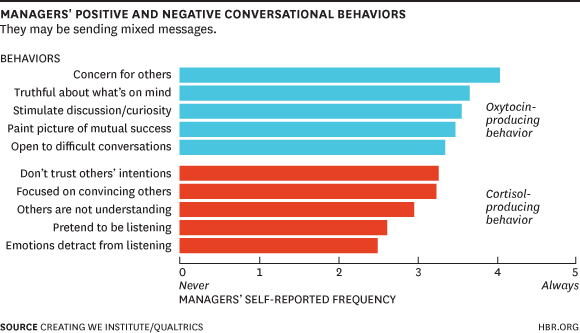
I had never heard of C-IQ or conversional IQ before, but positive conversation affect brain chemistry and this could mean a lot for your organization.
Yep, Facebook experimented with 700 000 of its users without their knowledge, and published their results in PNAS!
The general explanation: the users consent to anything and everything for the rest of their lives (Facebook lives) when they signed up to use the service. By that measure, every patient coming to our medical clinics agrees to be part of an experiment or trial and their data used for publication because they have agreed to be treated… OK, I am pushing the boundary a bit (maybe a lot) here but you get the picture and it is a bit absurd.
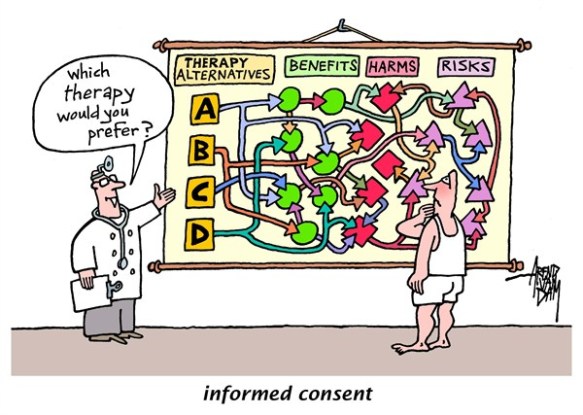 (* Cartoon from the Cagle Post by Arend van Dam)
However, this has lead to an interesting post on the concept of informed consent, which is at the heart of this kind of studies. It is an essential condition (but not the only one) to allow clinical or drug trials and robustly enforced by ethic committees, at least in the OCDE countries. While hospitals and physicians can use patient data for quality assurance purposes, publication of the said data cannot be made without the patient informed consent.
This could be a great general public education opportunity.

