
Your smartphone is closer to a Star Trek tricorder than you may think!
Smartphones have really become portable, and wearable, computing devices. They can process loads of data, do real-time tracking (through GPS) and various motion tracking via integrated multi-axis sensors. Increasingly, auxiliary devices can also be attached and link to via Bluetooth 4.0. A group of researchers has recently demonstrated that the CMOS at the heart of the integrated camera of smartphones can be used as radiation detection monitors!
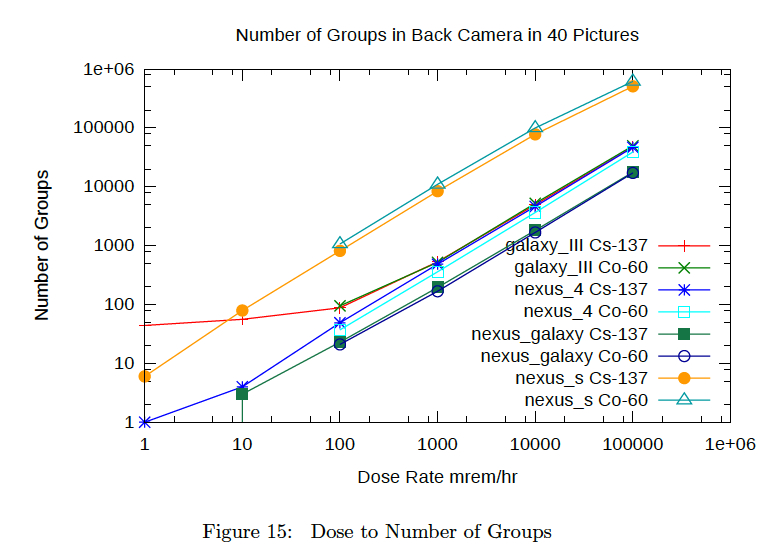
A recent paper by Joshua J. Cogliati, Kurt W. Derr, Jayson Wharton entitled “Using CMOS Sensors in a Cellphone for Gamma Detection and Classification”, and freely available on arXive, is demonstrating this of high energy gamma radiation and various Samsung. The idea is that when high energy photons (gamma radiations) hit the sensors, it generate high energy electrons that will leave fire the CMOS (or CCD) pixels that would otherwise have no signals. The produce “tracks” and the numbers of these tracks are representative of the amount of radiation measured by the device. This is shown on the figure above, Fig. 15 of that manuscript.
Beam me up Scotty!
 Ruminating...