
Human-computer interaction took a dramatic turn 30 years ago

Let’s go invent tomorrow instead of worrying about what happened yesterday.

– Steve Jobs

The release of the first Graphical User Interface or GUI for the masses happen on January 24th 1984 when Apple release the Macintosh. It deeply changes the face of the computer industry and how we interact with them.
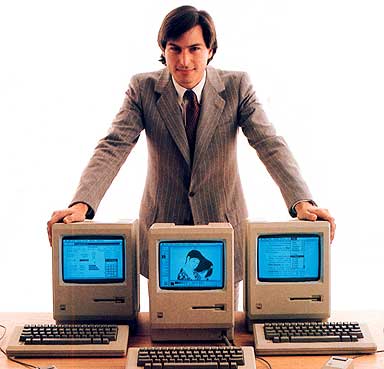
jobs1984

In 1985, our school dumped its old language lab (with tape players) for a network of Macintosh. That same school year, we did a fully digital school year book of the 1985-1986 graduates. Photos were actually scanned using a manual B&W scanner . All texts and final page preparations were done on the Mac! It took years to replicate any of this on another platform, replicate what was done with such facility by a bunch of teenagers. A few years later at the University, one of the major student journals, using a “specialized” DOS program called Ventura Publishing, was still not able to do true WYSIWYG publications.

Of course the famous 1984 commercial, By Ridley Scott(!), also became one of the best commercial ever produced. You can also find the Steve Jobs’ Mac introduction to the world video.

At the time, I had gone through the very beginning of the general public personal computing first hand with the TRS-80, Apple IIe, Vic 20 and Commodore 64. But what we did with the school Macs was, for the time, really exceptional. It was obvious to me that this was the future of the PC. I went on to work on mainframes and UNIX-based workstations (SUNOS and Solaris, HP AUX, Linux, …) for most of my early researcher career. But OSX changed everything again, no more secondary Linux box necessary, I could have everything on a single platform: the best of both world. In that, Steve Jobs’ NEXT Computer was really the next step… The NEXT computer was to play a role in the development of the World Wide Web!

Here’s to the crazy ones…

“Here’s to the crazy ones. The misfits. The rebels. The troublemakers. The round pegs in the square holes. The ones who see things differently. They’re not fond of rules. And they have no respect for the status quo. You can quote them, disagree with them, glorify or vilify them. About the only thing you can’t do is ignore them. Because they change things. They push the human race forward. While some may see them as the crazy ones, we see genius. Because the people who are crazy enough to think they can change the world, are the ones who do.

– Apple Inc, Think Different “

I’ve said it a couple of times, I like computers and electronic gadgets, in particular those gadgets that do what they are supposed to do without getting in the way. You can just use them and they work (for a useful amount of time)!

I got my first computer in early 1983 (a small Radio Shack unit) followed a few months later by a C64. It was a great computer and learned a lot of programming from it. But when I saw a Mac and had the chance to work with one in school in 1985, I knew what a computer would looked like moving forward. This gaming changing business happened again a few times for Apple. Before the iPhone, most “smart” phones where really not that smart and the top of the line was the Blackberry (an e-mail on the go device). Even early version of Android was geared toward competing with the BlackBerry…2007 marked a pivotal year for smartphone, and nobody ever looked back (expect for those trying to revisit history after the fact). The same is true for tablet computing. Tablets have been there for a long time before the iPad but it was not even considered a factor in term of selling volume. Just a few years after the iPad, the tablet is now a bigger market than the “traditional” PC.

The most interesting things about all of the above is that when launched, all were declared DOA by most “market experts” : computers with GUI were toy computers just good for playing (and I am not even talking about the mouse…), iPhone was Apple biggest mistake since no one in its right mind would buy a phone that has no physical keyboard and buttons. The iPad was just a big iPod Touch, no way of doing real work on them. The truth is that all of the above broke or shifted a paradigm, a way of doing things that was so entrenched that they were seen as set in stone.

The same is true for many aspects of life, including scientific research. Once in a while, you get comments that your research program or project (or even paper) cannot be successful because that would mean the usual way of doing things, of thinking would have to change. Oh boy, that would be so impractical…

This leads me to the quotation used in the opening of this blog post and Steve Jobs.

Steve jobs passed away over one year ago (on October 5th 2011). Yet I find it fascinating how much it still written, especially online, about him even today. Some praise him as one of the genius of our time. Others, like to tell that he or Apple, in fact, didn’t do anything all. It does not really matter; the point is, as stated in the quote: “you can quote them, disagree with them, glorify or vilify them. About the only thing you can’t do is ignore them.”. Clearly, he was someone who still can’t be ignored 😉

Steve Jobs delivered a great speech at Stanford University, which is worth listing to:

Steve Jobs: How to live before you die | Video on TED.com.