The best job is …

Choose a job you love, and you will never have to work a day in your life.

Confucius

My two teenagers have started their summer jobs as instructor and assistant instructor in specialized summer camps. This reminded me that when my son started his first summer job (last year), I asked him at the end of his first week how it was, if he liked it?

His reply was, I am having lots of fun and their paying me to for it!

This is a very important feeling, maybe the most important one when it comes to employement. I told him never to loose that feeling because whatever he choses to do later on in life, this how it should feel.

I also told him that this is exactly how I feel everyday in my line of work: scientific research and university teaching. Yes it is tought to get such a position, even thougher to thrive due to the highly competitive nature of publishing manuscripts and getting research grants. At the same time, I get to chose what I am working on and the perks are very satisfying in the end.

The best job is the one that does not feel like it 😉

Writing Your First Scientific Paper, Part I: The “Data/Story Flow”

You’ve been working hard, around the clock to get all the data out. You might even have submitted an abstract about your current to the great scientific meeting of your field (and maybe got to travel and present it). Now is time to plant the flag, leave your mark i.e. publish!

Continue reading

The perks of the job!

I realized it has been sometime since the last post (over a month in fact). Well during that time, I traveled over 50 000 kilometers. That is right, it is more than the equivalent of a long trip across the globe at the level of the equator (25% more in fact!). Before getting into the details, let me step back and explain where this is coming from.

Research is viewed as a competitive venture. At each point you have to prove yourself, your ideas and projects. Most of the time, this is done via reviews by your peers and, sometimes, justification to your administrators!

  • Granting agencies run “competitive” funding programs in  which your project or program get to be peer-reviewed, scored and financed or rejected (with various levels of feedback).
  • Manuscripts are peer-reviewed, sometimes going through multiple rounds before they get published (or rejected).
  • Conference abstracts / papers are peer-reviewed before being accepted at the various scientific meetings, either as oral presentations (the minority) or posters.
  • Getting the best students is a competition between you and your colleagues in your department.
  • Getting promoted to associate and full professor is also in itself a competitive process involving a review process.

If you ask, most researchers will tell you that the grant part is the tough one, takes a lot of time and for most program is met with relatively low success rates (quite often below 20% or 1 grant written in 5 (or worst) being financed.

There are however perks in conducting a successful research project or program. The first one is the fun and excitement of being at the front-front of your field, driving it and as a side effect (for me and my students at least) getting to play with the latest technologies. The second one is certainly the trill of having young scientists progressing, graduating and applying their knowledge, know-how in industry, hospitals, teaching and so on. Conversely, having these persons to interact with, pushing you to discover new things (even when it is only tweeter or Facebook. Yeah sometimes it does feel like I am old!). The other category are being accepted for presentations at meetings and getting to go. This tends to be a big thing for students… but also for the supervisor.

Presenting at a scientific meeting is the reward for having spent extra hours in the lab or in front of a computer to validate this experiment or that specific result. It also provide a new level of stress, that of presenting your new result or idea in front of an audience of specialists and survive! The bonus here is that you get to refine you message afterward, do a few more measurements or simulations. The likelihood that someone in that room (if you are going to a key meeting) will be a reviewer on the ensuing manuscript is quite high in the end.

In the past months, I have had the chance to present our works in New Orleans (USA), Geneva (Europe), Melbourne (Australia) and finally, Philadelphia (USA).  Some of these were invited talks i.e. my peers across the globe finding works we have done interesting and cutting-edge enough to have me as invited speaker or plenary speaker at their meetings. I take this last form of scientific dissemination of works as a pat in the back, an open congratulation that we did something good, exciting and useful in our field.

Notice, I used the “we” in the previous paragraph and not “I.” This is because in these presentations I never forget that getting from an initial idea to the final result involve numerous iterations and works of many, especially students,  postdoc and colleagues depending of the type of projects.

So this is what happen since my last post. I also had the chance to visit CERN while in Geneva. So look-out for the dedicated blog post on “big science.” I am leaving you with a few travel pictures. One does not do some many kilometers without taking one or two days off to look around – another perk of the job 😉

Geneva

CERN-ATLASGruyere

Left to right (click on each to get the full resolution): Geneva, ATLAS detector at CERN and a view from Gruyère medieval castle.

Melbourne1

Melbourne2

12apostoles

Left to right: Melbourne river-view, Graffiti alley, the 12 Apostles on the Great Ocean Road by mid-afternoon.

Talk with your thesis advisor on a regular basis

Each research group has its own dynamics. In some, entering grad students get a very detailed “charge” list saying for example, there is a group meeting every week, so on and so forth.

What ever those dynamics are, as a graduate student you should learn quickly how busy is your thesis advisor and start planning regular meeting with him/her. Do not hesitate to initiate a request to meet. These, in my opinion after being involved in supervising or co-supervising over 45 graduate students, should happen:

  • At least once a year to discuss the general direction of your research project and, starting at the end of year 2 (PhD), to plan the necessary steps toward your thesis completion 😉
  • Every time you think you are ready to publish a manuscript (but before spending too much time writing it!).
  • Every time you have significant new results (if not presented at the group meeting or if your group does not have group meetings).
  • At least once a month to avoid getting “stuck” for too long (again regular group meetings really help in this regards).

Of course, thesis advisors are also busy peoples, won’t be available for you 24/7 and one of their goal is to get you on the road to become an independant researcher yourself. However as a grad student, you should know that most thesis advisors loved the interaction with students and are available on a regular basis to discuss with them.

The minority of advisors that are consistantly  “unavailable” are usually well-known within their University / Department. It is your task as a prospective grad student to gather this information, to ask your future advisor the tough questions before signing for this significant portion of your life.

Applying the 80/20 principle to scientific productivity?

The secret [to scientific success] is comprised in three words— Work, Finish, Publish.
— Michael Faraday

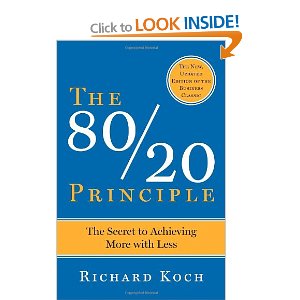
One of the thing I really like to do when waiting for a connecting flight at a major airport is to spent time at a book store. Not too long ago, I came to this book about the 80/20 principle.
80-20-principle

It stands just about 200 pages, which means a quick read and it had reference to Pareto. Being involved in computer optimization problems, in particular involving two or more opposing constraints, the notion of Pareto front is fresh to my mind. Similarly the notion that 80% of  the work can be achieve with only 20% of the feature of a software or 80% of the riches is held by 20% of the population or that is takes 80% of effort to accomplish the most demanding 20% of a project are all well-known applications of the discovery made by Pareto.

The book

The book explains the above principle with examples and also discusses how it apply to business, project managements and personal life. As you can expect, it take about 20% of the book to reach at least 80% (if not more!) of the goals set forth by it 😉

Still, overall an interesting and very fast read.

Can it be applied to science?

Well, a lot of what we do in research is program (collection of projects) and project-based. Therefore, it is always worth the effort to ask yourself why you are undertaking a new project, if it will contribute significantly to your overall research program and if the resources needed to accomplish it are available. It may very-well be that you will need to spent an enormous amount of effort  (let say 80%!) on a given project such that you will have to halt almost everything else. It better mare sense and pay off!

Can it be apply to analyze scientific productivity?

While reading the book I was wondering if only a small portion of my research program was really contributing to citations and impact on the field. I decide to quickly look at this by using Google Scholar. GS can track citations and h-index base on all of your papers and it takes last than 5 minutes to set-up (go over to scholar.google.com and chose “my citations” at the top right)

I will not providing my absolute numbers here. Still, fair enough my h-index is such that the value corresponds exactly to 20% of my published papers i.e. 20% of my published papers contribute to my h-index value. For example, for my h-index was 20, this would means that 20 papers have 20 or more citations and, it would also corresponds to the 20% most cited among 100 published manuscripts.

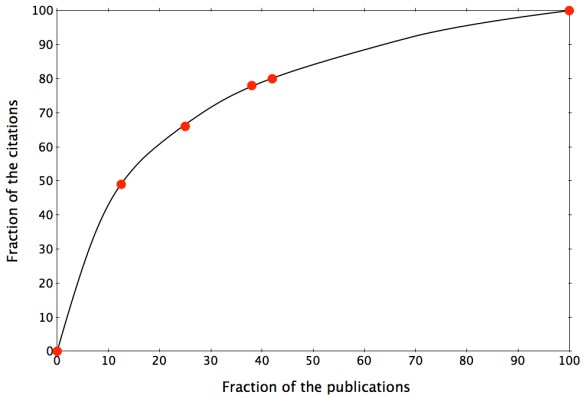
Next I look at the citations of each paper individually. On the figure below, you will find the fraction of total citations as a function of the fraction of manuscripts published.
Fraction-of-citations

It is quite interesting to see that a small fraction of all papers account for the majority of the citations. In my case, 13% of the manuscripts contribute to 50% of the citations and 42% contribute to 80% of the citations. So yes the Pareto principle is at play, but…

Limitations

If you were to ask me about each paper included in the 13% that gather 50% of the citations, I would reply:

  • Some I knew as we were preparing it that it would be important to the field.
  • Some I thought would be important but are not cited so much.
  • Some I thought were curiosities that would be of interest to only a few but ended-up as my most cited papers.

I think you get the message…

Conclusion

I can prove anything by statistics except the truth.
— George Canning

Yes, you can make statistics say anything. In the context of a creative process, predicting which of the creative action (here paper) will become a hit is actually rather easier after the fact than the other way around. Therefore, the concept might be interesting to track your resources (grant dollars, materials, projects to start, …) but it cannot be used, as expected I guess, to help you predict your future creative hit wonder!

The gift of doctoral study is…

“The gift of doctoral study is that you get the time and space to obsess about something you’re (hopefully) interested in…”

-Jeannie Holstein

The above is taken from the following link about returning to graduate school to tackle a PhD project and finding it fun. A very interesting read: ‘Academia is a very well kept secret’.