Big week at the 2013 AAPM meeting

Our group is well represented at this year AAPM meeting. 2 Faculty and 7 graduate students for a total of 11 oral presentations and 2 posters.

For a number of these students, it will be their first experience presenting at such a big event (over 3000 participants). Also for many of them, it will be their first scientific presentation in English. Hours of preparation and rehearsing for 5 minutes (snap oral) or 8 minutes (regular oral) presentations. While, I do tell them that the shorter the talk the more time (usually many hours!) is needed to select and organize the visual materials (aka slides), they do not realize it until we do the general repetition during our weekly group meeting.

For each talk, we can spend between 10 to 30 minutes going over the slides, suggesting modification, addition, removal, asking questions such as: what are you try to say? What is your main message? What do you want the audience to remember from this or that slide, …

Of course, senior grad students have it easier as they already know what to expect and prepare their presentations accordingly 😉

For my friends and colleagues in the medical field, see you in Indy.

Writing Your First Scientific Paper, Part I: The “Data/Story Flow”

You’ve been working hard, around the clock to get all the data out. You might even have submitted an abstract about your current to the great scientific meeting of your field (and maybe got to travel and present it). Now is time to plant the flag, leave your mark i.e. publish!

Continue reading

Journal Impact Factor: why you should not care… too much

I have been publishing scientific manuscripts for the past 22 years. My educated comments with regard to journal impact factor has always been the same (If you do not know what JIF is, please have a look at this Wikipedia entry). First order, you should publish in the most important journals for your field. If their JIF are low, who cares as long as your work is important to your field and well cited. For example, the scientific discovery of 2012 according to Science (very high JIF) is the publication of the experimental finding of the Higgs boson… in Phys Lett B (low JIF relative to Science)!

Do not forgot that from an historical perspective, we are awfully bad at predicting what will be the next important discovery down the road. A number of fundamental discoveries and early engineering feats were discarded at first. Similarly there are numerous example of scientists having had tremendous issues in getting those game-changing results published, even those ending up winning Nobel prizes. Karry Mullins’ PCR work is one of many examples of work was rejected by journals having top JIF but for which the application of this very technique was published in Science and Nature and the citations counts of these second generation papers also receiving higher numbers than the original, award-winning work!)

Now, you do not have to agree with this lone scientist opinion but certainly you should have a look at the The San Francisco Declaration on Research Assessment or DORA petition, which is supported by the “big boys” (no discrimination intended). The declaration statement is actually a very interesting read and it covers the historical origin of the JIF (which was not for evaluating researchers at all) and further call for dropping journal-based metrics in assessing scientific productivity for funding and promotion. Over 240 organizations and 6000 individuals have already signed the declaration.

In conclusion, do not loose a good night sleep over your favorite journals’ impact factors…

Has the Canadian Government declared war on science?

A post by John Dupuis on Science Blogs seems to think so and it started over 7 years ago: The Canadian War on Science: A long, unexaggerated, devastating chronological indictment – Confessions of a Science Librarian.

That being said, do not forget that Canada’s Sciences Minister is actually a creationist; It is sad.

NOTE ADDED [May 25th]: The Science, Technology and Innovation Council just publish its 3rd public report on the performance of Canada in Science and Technology. Between 2008 and 2012, Canada’s ranking in term of expenditure decreased significantly from 16th out of 41 OECD member countries to 23rd.

The perks of the job!

I realized it has been sometime since the last post (over a month in fact). Well during that time, I traveled over 50 000 kilometers. That is right, it is more than the equivalent of a long trip across the globe at the level of the equator (25% more in fact!). Before getting into the details, let me step back and explain where this is coming from.

Research is viewed as a competitive venture. At each point you have to prove yourself, your ideas and projects. Most of the time, this is done via reviews by your peers and, sometimes, justification to your administrators!

  • Granting agencies run “competitive” funding programs in  which your project or program get to be peer-reviewed, scored and financed or rejected (with various levels of feedback).
  • Manuscripts are peer-reviewed, sometimes going through multiple rounds before they get published (or rejected).
  • Conference abstracts / papers are peer-reviewed before being accepted at the various scientific meetings, either as oral presentations (the minority) or posters.
  • Getting the best students is a competition between you and your colleagues in your department.
  • Getting promoted to associate and full professor is also in itself a competitive process involving a review process.

If you ask, most researchers will tell you that the grant part is the tough one, takes a lot of time and for most program is met with relatively low success rates (quite often below 20% or 1 grant written in 5 (or worst) being financed.

There are however perks in conducting a successful research project or program. The first one is the fun and excitement of being at the front-front of your field, driving it and as a side effect (for me and my students at least) getting to play with the latest technologies. The second one is certainly the trill of having young scientists progressing, graduating and applying their knowledge, know-how in industry, hospitals, teaching and so on. Conversely, having these persons to interact with, pushing you to discover new things (even when it is only tweeter or Facebook. Yeah sometimes it does feel like I am old!). The other category are being accepted for presentations at meetings and getting to go. This tends to be a big thing for students… but also for the supervisor.

Presenting at a scientific meeting is the reward for having spent extra hours in the lab or in front of a computer to validate this experiment or that specific result. It also provide a new level of stress, that of presenting your new result or idea in front of an audience of specialists and survive! The bonus here is that you get to refine you message afterward, do a few more measurements or simulations. The likelihood that someone in that room (if you are going to a key meeting) will be a reviewer on the ensuing manuscript is quite high in the end.

In the past months, I have had the chance to present our works in New Orleans (USA), Geneva (Europe), Melbourne (Australia) and finally, Philadelphia (USA).  Some of these were invited talks i.e. my peers across the globe finding works we have done interesting and cutting-edge enough to have me as invited speaker or plenary speaker at their meetings. I take this last form of scientific dissemination of works as a pat in the back, an open congratulation that we did something good, exciting and useful in our field.

Notice, I used the “we” in the previous paragraph and not “I.” This is because in these presentations I never forget that getting from an initial idea to the final result involve numerous iterations and works of many, especially students,  postdoc and colleagues depending of the type of projects.

So this is what happen since my last post. I also had the chance to visit CERN while in Geneva. So look-out for the dedicated blog post on “big science.” I am leaving you with a few travel pictures. One does not do some many kilometers without taking one or two days off to look around – another perk of the job 😉

Geneva

CERN-ATLASGruyere

Left to right (click on each to get the full resolution): Geneva, ATLAS detector at CERN and a view from Gruyère medieval castle.
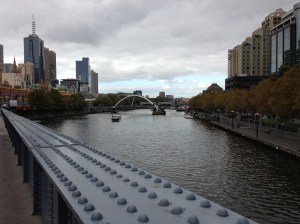
Melbourne1

Melbourne2

12apostoles

Left to right: Melbourne river-view, Graffiti alley, the 12 Apostles on the Great Ocean Road by mid-afternoon.

Talk with your thesis advisor on a regular basis

Each research group has its own dynamics. In some, entering grad students get a very detailed “charge” list saying for example, there is a group meeting every week, so on and so forth.

What ever those dynamics are, as a graduate student you should learn quickly how busy is your thesis advisor and start planning regular meeting with him/her. Do not hesitate to initiate a request to meet. These, in my opinion after being involved in supervising or co-supervising over 45 graduate students, should happen:

  • At least once a year to discuss the general direction of your research project and, starting at the end of year 2 (PhD), to plan the necessary steps toward your thesis completion 😉
  • Every time you think you are ready to publish a manuscript (but before spending too much time writing it!).
  • Every time you have significant new results (if not presented at the group meeting or if your group does not have group meetings).
  • At least once a month to avoid getting “stuck” for too long (again regular group meetings really help in this regards).

Of course, thesis advisors are also busy peoples, won’t be available for you 24/7 and one of their goal is to get you on the road to become an independant researcher yourself. However as a grad student, you should know that most thesis advisors loved the interaction with students and are available on a regular basis to discuss with them.

The minority of advisors that are consistantly  “unavailable” are usually well-known within their University / Department. It is your task as a prospective grad student to gather this information, to ask your future advisor the tough questions before signing for this significant portion of your life.